
By João Gomes
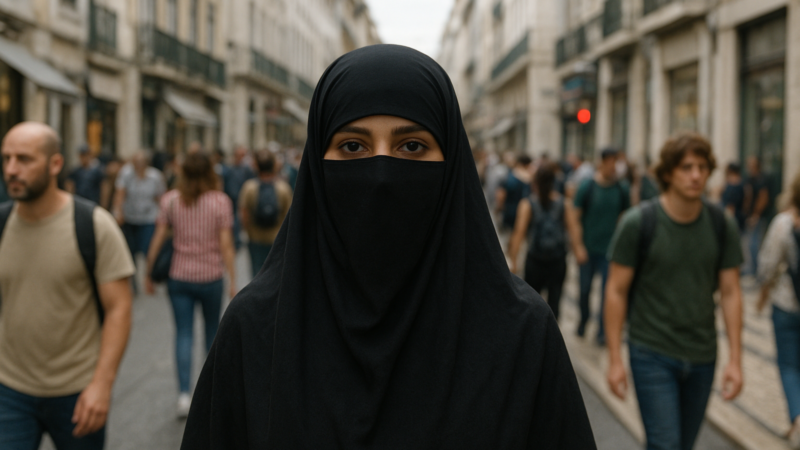
Portugal awoke this week to a legislative epiphany: the burqa — that piece of fabric covering the faces of some Muslim women — has now been deemed officially suspect. Yes, it seems the greatest threat to public safety is not pickpockets, forest fires, or road accidents, but a garment that almost no one wears.
The number of women wearing burqas in Portugal is so small that if they all vanished overnight, the National Statistics Institute would probably have to invent a figure to justify their existence. Yet the right-wing in the Assembly of the Republic, in its providential zeal, decided that even a handful of veiled citizens pose a civilisational risk. Who needs effective policing when religious morality can be regulated through fabric?
And there’s more: the woman who chooses to wear a burqa often does so not because she is forced to, but because she wishes to — in the name of her faith, her family’s respect, and her religious conscience. It is a voluntary act, born of deep conviction. But apparently, in Portugal in 2025, the freedom to dress according to one’s beliefs now requires a law to prevent it.
It’s impossible not to recall the good old days of nuns and friars, who patrolled the moral lives of the Portuguese in habits and cilices, ensuring that faith and decency were upheld “in the name of the people”. They didn’t need statistics: surveillance was personal, moral, and ever-present. Now, centuries later, we’ve replaced habits with burqas, cilices with parliamentary debates, and voilà — we have democracy legislating on clothing.
And here’s the icing on the cake: the Constitution guarantees freedom of religion. Every citizen may profess their faith, worship, or dress as they wish. Banning the burqa? A touch of legal comedy — it’s like banning nuns’ habits or friars’ robes, only this time in the name of public safety, which always seems more afraid of veils than of actual crime.
The paradox is delicious: once upon a time, the religious habit of a minority signified authority and friendship with God; today, it invites legislation and potential unconstitutionality. Portugal ever eager to prove that democracy is not incompatible with irony: without a burqa, freedom may still endure — but for how long before we start legislating the length of sleeves, the width of collars, or the height of skirts, all in the name of public safety?
In the end, the question remains: are we protecting society, or simply teaching ourselves to admire legislative zeal as if it were a monk’s robe? And who knows — perhaps tomorrow smiling in public will be forbidden, since a smile, too, can conceal dangerous intentions.
By the way, will this law be scrutinised by the Constitutional Court? The judges there might feel rather touched by it — after all, their robes are splendid disguises for robbery. All that’s missing is the hood!
*João Gomes, Portuguese writer and poet