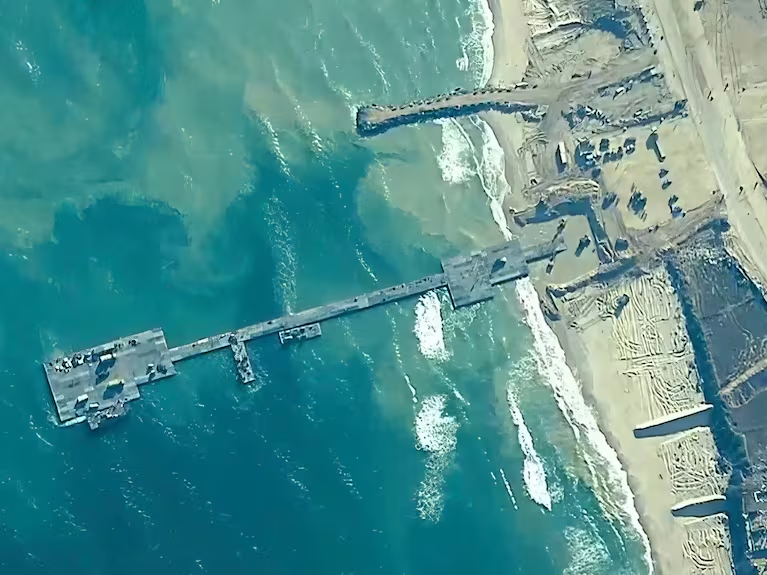
This file image provided by U.S, Central Command, shows U.S. Army soldiers assigned to the 7th Transportation Brigade (Expeditionary), U.S. Navy sailors assigned to Amphibious Construction Battalion 1, and Israel Defense Forces placing the Trident Pier on the coast of Gaza Strip on May 16, 2024. AP / U.S. Central Command
By Noha Khalaf, from Amman (Jordan)
Despite all claims of a ceasefire, and in light of the brutal and destructive war the Zionist occupation forces have waged on the Gaza Strip for two years — and their declaration that they will continue the war until all of Hamas’s tunnels are destroyed — we must continue to investigate and raise questions about the hidden and evident reasons behind this blatant aggression, which has caused the martyrdom of more than sixty thousand Palestinians and injured one hundred thousand innocent Palestinians.
Although the Zionist entity continues to claim that what happened on October 7 was the reason for launching this indiscriminate war, a review of history makes it clear that there are other direct and indirect reasons behind this aggression.
When examining the long history — over a century — of the Zionist war to seize the land of Palestine, it becomes clear that this is not the first time Zionist occupation forces have destroyed entire Palestinian areas, villages and towns, dispossessing their inhabitants and seizing their lands in order to displace them, as happened during the Nakba of 1948. A deeper look shows that the land seizure was not only of Palestinian agricultural land to establish settlements, but also aimed at occupying the Palestinian beaches in order to control the sea.
Although this strategy aimed at controlling the sea was not obvious in the early stages of the Zionist project, it became clearer by the mid-1930s.
While Jabotinsky — leader of the Revisionist Zionist movement and the spiritual mentor of Netanyahu — was the first to coin the term “the Jewish sea” and to criticize the Zionist movement for ignoring the importance of the sea, he even fabricated the myth of a historical Jewish relationship with the Phoenicians in Tyre and Sidon in southern Lebanon to prove their maritime connection, yet David Ben-Gurion, one of the founders of the Zionist Labor Party, said in a speech at a fishermen’s conference in Haifa in 1943: “There will be two Jewish revolutions: one in the Jewish village and the other in the Jewish sea, because they are two sources of life that blend heroism and strength. Through both, the human being rises, for in both man dominates nature, and that is the greatness of human destiny, and also the greatness of the Jewish destiny. The globe is mostly sea, and our land is mostly sea as well. The land’s coast does not form a border but a bridge extending into the spaces of the sea to the west and south.”
Through these words Ben-Gurion made clear that the role of the sea in the future Jewish state would be twofold: first, that Jewish settlement along the coast of the Zionist state would be decisive for the strength of the state; and second, the country’s coasts would function as a gateway to the sea and as a necessary link with neighboring countries.
Although the agricultural settlements(kibbutzim), and the state’s diplomatic and political efforts formed an important part for completing the Zionist settlement plan at first, the organization of clandestine immigration by sea turned the eastern Mediterranean into a vital theater for the colonial project.
This study aims to analyze what is called the “Zionist maritime revolution” in terms of its infrastructure, institutions, and impact on the emergence of the Zionist state. After the early occupiers were preoccupied with agriculture and control of the land, their attention turned to the geopolitical situation in Palestine during the British Mandate period, and the strategic importance of controlling the sea quickly emerged. Because the region was surrounded by Arab populations and Britain imposed strict limits on immigration, the Mediterranean became the most feasible route for mass immigration, trade, and contact with the Jewish diaspora.
Whereas the port of Jaffa was the traditional gateway to Palestine, it was not suitable for modern ships, which led to the construction of the modern Port of Haifa, completed in 1933 under the British Mandate. This port became a lifeline for Jewish immigration, contributing to trade, the import of essential goods, and the reception of large numbers of immigrants. Smaller maritime projects — such as piers and maritime training centers — laid the foundations for the economy and the defense of the Zionist entity. In response to strict barriers to Jewish immigration, Zionist organizations organized secret sea migrations known as Aliyah (immigration waves) that transported tens of thousands of Jewish migrants to Palestine in defiance of British patrols. Ships like the Exodus (1947) became symbols of Jewish defiance of British opposition. These maritime operations had a significant effect in preserving Jewish demographic growth and gaining international sympathy for the Zionist cause.
Recognizing the need for maritime expertise, Zionist organizations established institutions such as the maritime school in Acre and programs to train sailors. These initiatives not only provided practical skills but also instilled the idea of seizing the sea among Jews. Many of these trainees later formed the nucleus of the nascent Israeli naval forces, confirming the direct link between pre-state maritime activity and the later Israeli military infrastructure.
The maritime revolution was not limited to economic aspects; it also extended to critical military dimensions. In the 1948 war, sea supply lines were essential to the survival of the Zionist state. Naval units, which drew on experiences from earlier clandestine immigration efforts, defended the coasts and secured supply routes. The Israeli navy, officially established in 1948, benefited from the human and technical expertise accumulated by earlier maritime operations.
The “Zionist maritime revolution” embodied a broader transformation: from a land-focused agricultural movement to a modern state capable of economic, military, and technical adaptation. The “ invasion of the sea” was a pivotal step in ensuring the survival of the Zionist movement during critical periods and paved the way for its emergence as a future maritime power in the eastern Mediterranean.
The Zionist maritime revolution was a multi-dimensional phenomenon that included infrastructure development, organization of clandestine immigration, training of maritime cadres, and establishment of shipping companies. It played a central role in shaping the economic and demographic capabilities and contributed to the growth of the technical and military power of the Zionist entity, as well as strengthening its sense of the necessity of sovereignty. The strong maritime presence of the Zionist occupation today is a continuation of that “transformative phase” in Zionist history, and thus the seizure of historic Palestinian ports played an important role in strengthening the Zionist entity.
Haifa Port became one of the three main international ports of the Zionist entity along with Ashdod and Eilat Ports. Today Haifa is considered one of the largest ports in the eastern Mediterranean in terms of cargo volume; it handles more than 30 million tons of goods annually and employs more than 1,000 people at the port, with the number increasing to 5,000 when ships are docked. Haifa Port is located in the northern part of downtown Haifa on the Mediterranean Sea and extends about 3 kilometers along the city’s shoreline, with activities ranging from military to industrial and commercial.
Haifa Bay has been used by sailors since ancient times; its oldest known settlements date back to the late Bronze Age. The port was very important during the Crusader wars in the twelfth century, but it later declined during the Mamluk and Ottoman periods. By the eighteenth century the port had a reputation as a haven for pirates. In the late Ottoman period, the port became an important link in regional trade networks. After the British occupation of Palestine in 1918, Haifa grew significantly due to increased immigration, and the British began planning the construction of a modern deep-water port to serve the region.
Although construction began in 1922, the port officially opened in October 1933. This port facilitated trade and became the main entry point for thousands of Jewish immigrants from Europe after World War II. In the UN Partition Plan the port was included within the territory of the new Jewish state. After the 1948 war, the port continued to expand under Zionist administration and became the largest and most important of the three major Israeli ports; it is estimated that Haifa Port handles fifty percent of the entity’s trade. In 2015 a tender was announced to grant a special concession to operate a new terminal, a step that introduced advanced technologies to the port after it had also faced political and logistical challenges.
As for Ashdod Port, it is historically linked to the ancient city of Ashdud . which had been village of Isdud during the Umayyad and Crusader eras, then declined as an important center for trade and agriculture along the coastal road. Ashdod Port was later built by the Fatimids and Crusaders. The port is not mentioned after the Ayyubid and Mamluk periods, probably due to fear of renewed Crusader sea invasions. Nevertheless, the village of Isdud became an important postal station on the route between Gaza and Syria and a principal stopping point for travelers on the way to Jaffa.
By the nineteenth century, the khan (caravanserai or old inn) was destroyed and dismantled for its building materials, but the village prospered during the British Mandate and became a center of agriculture and trade, with a population of around five thousand. During the 1948 war the Egyptian army occupied Isdud, making it their northernmost position. It was then attacked and besieged by Israeli forces, which led to the displacement of most of its population. The modern Zionist city of Ashdod was built on the ruins of historic Isdud, and the Israeli army ordered the expulsion of the remaining inhabitants; the original people of Isdud became refugees in the Gaza Strip.
The third important port is Eilat (Um al-Rashrash), whose story is strategically important. Its construction began between 1952 and 1956 and it began operations and shipping in 1957 as the southern gateway of the Zionist entity to bypass the Suez Canal in trade with Asia and the Far East. Its history was therefore marked by geopolitical conflicts, especially during the Suez Crisis and the Six-Day War, which were linked to attempts by the occupation to reach the Straits of Tiran. The port was in the past a major center for exporting minerals and importing cars, but it has seen a sharp decline due to changes in container shipping patterns, and its financial crisis has worsened recently.
As for Gaza Port, despite attempts by the Palestinian Authority to inaugurate it, the decision to open it has remained ink on paper.
The story of the Palestinian ports and the Zionist seizure of the Palestinian coast is merely a continuation of the Zionist plan aimed at displacing and strangling the Palestinian people, and it shows that the plan to create a Palestinian state in the West Bank is part of the Zionist plan to strip the Palestinians of access to the sea. Since the Gaza coast is the only remaining stretch of the Palestinian coastline, it appears clear that the recent brutal genocidal war on the Palestinian people in Gaza is a last desperate attempt to complete the seizure of what remains of this coast. The discovery of natural gas fields in the waters off Gaza has also increased its importance and the Zionist covetousness of this area.
Trump’s plan and the surrounding fuss — makes of him a key actor and main protagonist in the fate of the small land of Gaza, especially since Trump repeatedly vowed to visit it as a liberating knight and had announced his dream of turning it into a “modern Riviera” — leaving Gaza’s fate in limbo.
The worrying strategic question posed today remains: will Gaza survive the strategy of seizing the sea and the ambitions and betrayals of the new colonizers’ alliance?