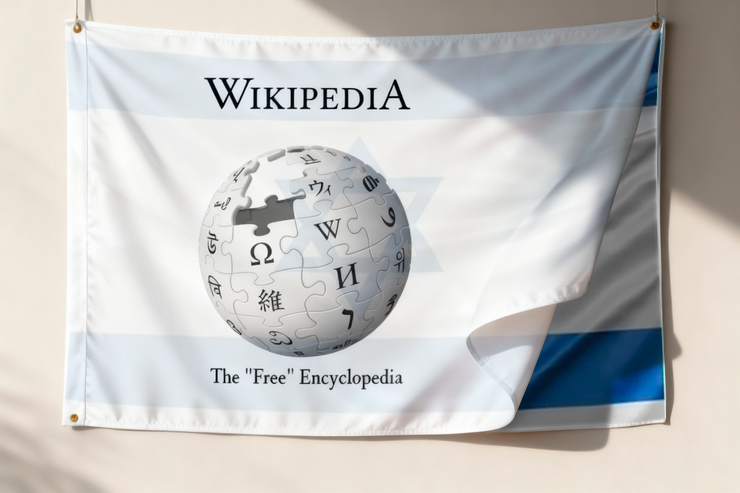
Wikipedia — the world’s largest collaborative encyclopaedia — is facing serious allegations of systematically blocking edits related to the genocide in Gaza and censoring content that documents war crimes committed by the Israel Defense Forces (IDF) and by the State of Israel. The criticism comes from journalists, researchers, digital activists and press freedom organisations who see in the platform a growing pattern of editorial suppression and ideological intervention.
International bodies, including UN commissions, special rapporteurs, legal experts and the International Court of Justice, have already described Israel’s actions in Gaza as genocide, in accordance with the 1948 Convention. Yet, according to affected editors, contributions citing these documents are being removed, reverted or blocked, preventing the public from accessing verified updates on:
- Israeli attacks on civilians and protected infrastructure;
- the killing of Palestinian and foreign journalists;
- violations of the Geneva Conventions, including the bombing of hospitals, schools and humanitarian convoys;
- official statements issued by UN bodies and international investigative missions.
Critics argue that Wikipedia’s moderation has begun to curate political narratives, obstructing information that contradicts pro-Israel or government-aligned interpretations of the conflict.
Protected pages and silenced contributors
Several entries relating to the genocide have been placed under full or semi-protection, blocking new editors from contributing. Users report that even well-sourced edits — based on UN reports, Human Rights Watch investigations, Médecins Sans Frontières testimonies or findings from the International Court of Justice — are routinely dismissed.
Edits referring to crimes of war — explicitly defined under the Geneva Conventions, including deliberate attacks on civilians, journalists and essential infrastructure — have been rejected despite extensive documentation by international news agencies and humanitarian organisations.
For specialists, this behaviour reflects a politically filtered approach to knowledge, reinforcing asymmetry in how narratives about Israel’s actions are allowed to appear on the platform.
The suppression of the Hassan Project
The controversy intensified with the case of the Hassan Project, a collective pseudonym created in 2025 that allows journalists, writers and activists to publish verified reports on Palestine while safeguarding their anonymity — vital in a context where reporters face persecution, threats and targeted killings.
The initiative includes a public manifesto, strong ethical guidelines, rigorous verification standards, a focus on source protection and a rotating editorial council. Inspired by open-identity traditions like the Luther Blissett Project, it addresses contemporary threats to journalists in conflict zones.
Nevertheless, the proposed Wikipedia article on the Hassan Project was:
- rejected during the Articles for Creation process;
- labelled as promotional despite its neutral tone;
- linked to a prohibited “role account”;
- followed by an indefinite block of the submitting editor;
- targeted for speedy deletion on grounds of advertising.
Before being blocked, the editor wrote that they had “expected neutrality but found an administrative environment hostile to independent journalism that exposes crimes committed by the State of Israel”.
Experts highlight governance issues and political influence
Media governance researchers note that disputes over politically sensitive topics are expected on Wikipedia, but the Gaza case appears unprecedented in intensity and scale. The platform faces accusations of transforming legitimate, verifiable information into alleged “advocacy” when such information implicates the IDF or the Israeli state.
Human rights advocates add that such practices can distort public understanding, especially when they suppress data recognised by international courts and humanitarian investigators.
A global struggle over memory and narrative
The allegations against Wikipedia raise an essential question: who controls the historical record of the Gaza genocide? When one of the world’s most influential reference platforms restricts information validated by international bodies, the result is not neutrality — it is erasure.
For journalists and activists, the suppression of edits and the rejection of the Hassan Project demonstrate that Wikipedia’s moderation is operating as a politicised filter, obstructing documentation of crimes recognised under international law.
Though the Wikimedia Foundation denies bias, experts argue that the issue is structural rather than declaratory — embedded in the opaque governance mechanisms that shape what becomes “knowledge” online.
And so, the central question remains:
how can truth be preserved if the platforms meant to document it actively restrict facts acknowledged by the international community?