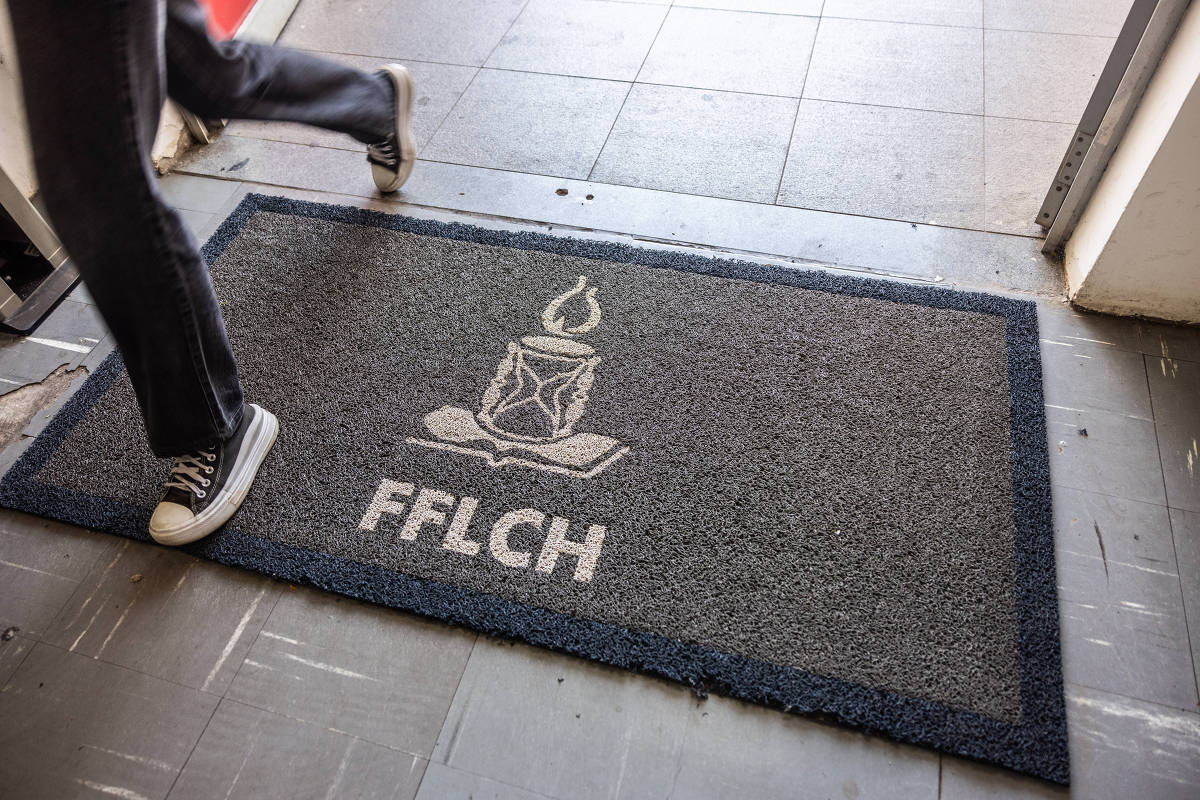
Carpet with the FFLCH logo in the Social Sciences building – Pedro Affonso – 27 Nov 2024 / Folhapress
- Breakup according to Israeli university does not address individual researchers
- FFLCH decision expresses adherence to all voices calling for an end to genocide
After a lengthy debate, the Congregation of the FFLCH (Faculty of Philosophy, Languages and Human Sciences) at USP decided, by a large majority (46 votes in favour, 4 against and 4 abstentions), to terminate its cooperation agreement with the University of Haifa (Israel).
It was a carefully considered decision, following extensive discussions in which all viewpoints were heard and given space for argument. The prevailing understanding was that the practice of genocide, committed by the Israeli state and supported by its institutions, must be met with a clear gesture of repudiation from the international community.
As a result of its ethical stance, FFLCH — the largest faculty of humanities in Brazil and Latin America — has been slandered and accused of practising “intolerance” and “selective hostility” towards Israel.
Its detractors seem eager to ignore that the University of Haifa is an organic part of the Israeli state, hosting three military colleges that make up the Israeli Military Academic Complex, which the university itself declares to be “the backbone of the elite training programmes of the IDF [Israel Defence Forces].”
A simple reading of the university’s own website reveals that it offers courses at the Glilot military base and provides equipment to soldiers who perpetrated the massacre in Gaza.
These detractors claim that FFLCH is being intolerant by severing an academic agreement, yet they conceal from public opinion that this rupture is not directed at individual researchers and has little impact on scientific cooperation among academics themselves.
The exchange of lecturers continues; student exchanges never even took place. This act of rupture is, in fact, the way academic institutions express their strong opposition to a criminal situation — genocide — which has been normalised, concealed and even supported not only by the University of Haifa and other Israeli academic institutions but also by several sectors of Brazilian civil society.
The FFLCH of USP, just like Unicamp and other conscientious Brazilian universities, did not avert its gaze, nor pretend that it bore no academic responsibility to speak out against this crime.
The UN itself and the International Court of Justice recognise that it is the duty of member states not to collaborate with Israel’s violation of international law through its illegal occupation of Palestinian territories. In other words, academic and cultural boycotts, as well as economic sanctions against Israel while it maintains such flagrantly illegal situations, are grounded in international law.
When the global system fails, it is up to states, their institutions, and civil society to ensure that international law is enforced.
Criticisms of FFLCH also disregard the public letter “Jews Demand Action”, released only a few weeks ago by an international group of Jewish academics and intellectuals, and signed by thousands of Jews around the world. The letter emphatically states that “international pressure must continue so that we may reach a new era of peace and justice for all, Palestinians and Israelis alike.”
Therefore, far from expressing “intolerance”, FFLCH’s decision represents alignment with all those voices today calling for an end to genocide through measures — whether symbolic or effective — that are always non-violent: academic, cultural, commercial and military boycotts of the state and institutions that commit or normalise acts of genocide and ethnic cleansing.
FFLCH refuses to hide behind a supposed institutional neutrality when what is at stake are tens of thousands of human lives — lives eliminated and mutilated through a long process of domination, dehumanisation, colonialism and, now, bloody genocide.