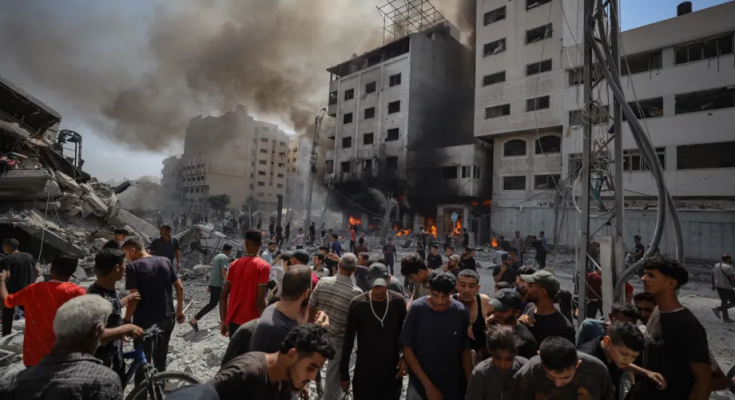
Firefighters try to extinguish a fire that broke out after Israeli attacks on a house belonging to the Al-Shawa family at the Samer junction in Gaza City, Gaza on September 22, 2025. [Khames Alrefi – Anadolu Agency]
By Jawdat Manna, from Jerusalem
I contemplate Gaza as if it were another Berlin rising from its ashes.
In Germany, after World War II laid down its weapons, women emerged from the rubble, carrying stones with bloodied hands, to begin the journey of rebuilding from scratch.
German cities were destroyed, men lay in cemeteries or captives, and the country was riddled with loss; yet, life regained its pulse through the hands of women who took on the burden of rebuilding for their nation.
And today, eight decades later, history repeats itself in Gaza. Palestinian women, alongside the men who survived the Israeli war of extermination against the Palestinian people, rise from the rubble, gather what remains of their homes, their children, and their dreams, and begin again.
Even though the war is not yet over, the sky continues to rain fire. Eighty percent of the Gaza Strip is destroyed, but in the women’s eyes, there is a light that never fades and a determination that borders on the miraculous. In the West Bank, including Jerusalem, the terror of Zionist settlers continues to compound the dread that hangs over Palestinian villages, cities, and refugee camps, which await settler attacks at any moment.
However, the harsh historical irony lies in the nature of the two wars. The war against Germany was a war against Nazism, which invaded Europe and the Soviet Union; the war against Palestine is waged by Zionist Israel, which claims to represent the victims of Nazism but perpetrates acts against the Palestinians that resemble its crimes.
From yesterday’s victims to today’s executioners, the roles are reversed, and the pain remains the same. And those who support Israel’s war of extermination are the same countries that waged the war against Germany.
Gaza today tests the world’s conscience as Europe did eight decades ago.
And, in the face of all this devastation, the Palestinian woman, like her German counterpart of old, remains a symbol of human survival in times of annihilation, and the seed of hope that neither siege nor fire can burn.
Editor: Alexandre Rocha