
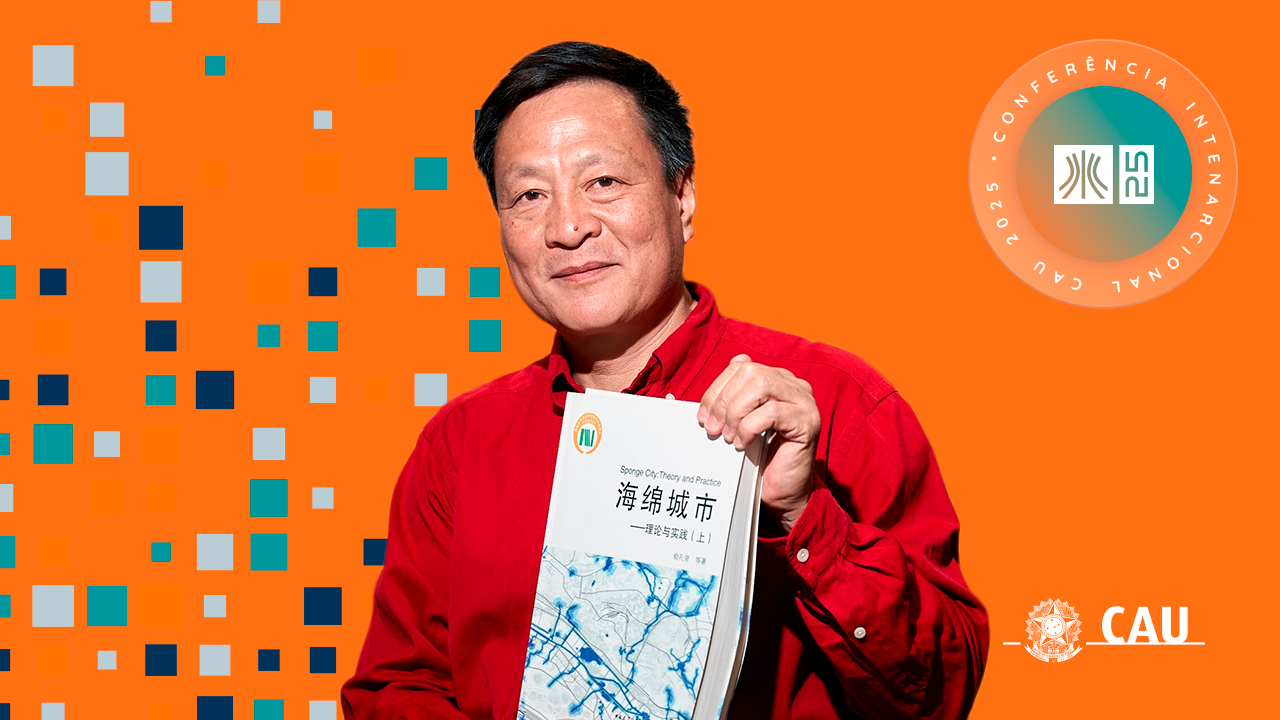
Chinese architect Kongjian Yu, recognized worldwide for his concept of "sponge cities," was one of the keynote speakers at the CAU 2025 International Conference. Image: Ascom | CAU/BR
On September 24, 2025, the architecture and ecological urbanism world was struck by tragedy: Kongjian Yu perished in a plane crash in the rural Pantanal region of Brazil (Aquidauana, Fazenda Barra Mansa) while attending the 14th São Paulo International Architecture Biennial.
While the official narrative frames it as a fatal accident, we must interrogate deeper: could this have been a deliberate act? Could the forces of capitalism — threatened by Yu’s radical critique of urban modernity — have ordered his elimination? Before speculating further, we retrace his life and ideas, to understand what kind of voice may have been silenced.
Early Life, Education, and Career
Kongjian Yu was born May 12, 1963 in Dongyu Village, Jinhua, Zhejiang Province, China, into a peasant family. In his youth, his family was labeled as “landlord class” during China’s Cultural Revolution, which impeded his educational access — a setback later reversed under reformist policies.
He obtained his bachelor’s and master’s degrees in landscape architecture at Beijing Forestry University. Later, he earned a Doctor of Design at Harvard Graduate School of Design in 1995 with a dissertation titled “Security Patterns in Landscape Planning.” After graduating, he worked with SWA Group (1995–1997) before returning to China to embark on a career that would change the direction of urban design in his country and beyond.
He founded Turenscape, a landscape architecture and ecological restoration design firm, and concurrently took academic leadership roles at Peking University, where he founded the Graduate School of Landscape Architecture and led the College of Architecture and Landscape Architecture. Over his lifetime, Yu published more than 300 academic articles, authored over twenty books, and carried out hundreds of built projects across 200+ cities.
His accolades include the Sir Geoffrey Jellicoe Award, the Cooper Hewitt National Design Award, and the 2023 Cornelia Hahn Oberlander International Landscape Architecture Prize, among others.
Core Ideas and Theoretical Contributions
Ecological Security and Green Infrastructure
Yu’s work emphasized that modern cities frequently sever themselves from essential ecological network structures — from watercourses to wetlands to biodiversity corridors. His ecological security patterns concept sought to map and protect those key elements, enabling the rest of the urban system to coexist with nature.
Negative Planning & Urban Form
He advanced negative planning (or “reversed planning”), advocating that urban growth should respect the existing “negative” or reserved ecological spaces, rather than overlaying development on top of nature. In other words, one plans by subtraction, preserving the ecologically vital before filling in the rest.
Sponge Cities & Sponge Planet
Yu’s signature concept, sponge cities, rejects the conventional gray infrastructure of canals, drains, pipes. Instead, cities would act like sponges: absorbing, filtering, storing, and gradually releasing stormwater. The method reduces flooding, improves water quality, supports groundwater recharge, and enhances urban ecosystems.
China has adopted this idea as national policy, implementing thousands of projects led by Turenscape and allied institutions. Yu extended this to planet sponge, a vision of global ecological restoration of wetlands, watersheds, and coasts to rebalance the planetary water cycle.
Aesthetic & Cultural Critique
Yu contrasted what he termed “little-foot aesthetics” — a manicured, controlled, ornamental landscape — with a “big-foot aesthetics” grounded in ecological function, resilience and inclusivity. He rejected separation between humans and nature in favor of integrated, living urban ecologies.
Hypothesis of Death as a Political Act: Holding Capitalism Accountable
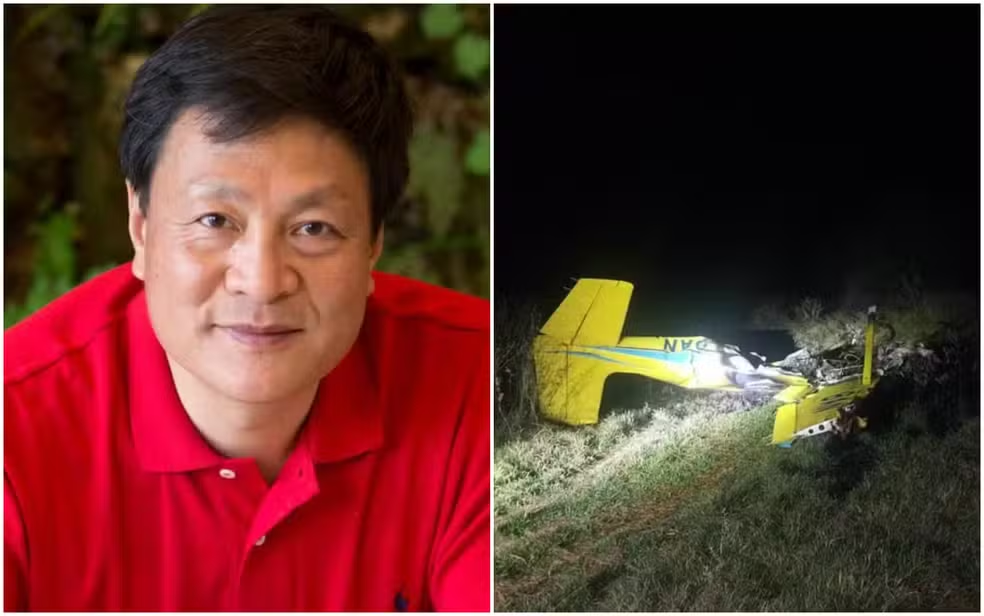
Kongjian Yu died in a plane crash in the Pantanal — Photo: Personal archive; Civil Police-MS
Yu’s death in an air crash is presented as a random tragedy. Yet, when we confront what he stood for — resistance to extractivist urban models, criticism of rampant speculation, and the promotion of ecological alternatives — it becomes legitimate to ask: who stood to gain from his silence? Who benefited from the elimination of a powerful voice against the vices of capitalist urban power?
The official narrative, that “the plane went down,” serves as a convenient cover. But several points must be considered:
- Only a drastic act silences a formidable adversary. Different forms of pressure — academic, political, legal — often fail or even create backlash. Physical elimination is the extreme measure that prevents the continuation of ideas capable of eroding deeply entrenched structures.
- Ecological urgency and economic conflict. Yu’s proposals threatened the interests of property developers, construction companies, hydraulic engineering monopolies, and conventional drainage industries. “Urban capitalism”, which privileges immediate profit over ecological resilience, regarded Yu’s discourse as an obstacle.
- A conspiratorial scenario: the explosion as a guarantee of effectiveness. Even acknowledging that accidents involving air taxis (or small planes) are exceedingly rare, the hypothesis of sabotage remains credible in contexts of high political and environmental tension. The explosion of the aircraft — if confirmed — would be a brutal mechanism to ensure there were no survivors, no straightforward investigation, and that the case would be rapidly closed.
These arguments do not prove the matter — but they open up an urgent field of questioning: Yu’s death cannot be treated as a mere “natural fatality” without political crime hypotheses being seriously examined. Independent investigation and maximum transparency are required, not only in Brazil but also internationally, given his global role.
Addendum: The Extremely Low Probability of an Air Taxi Crash — and Explosion as a Guarantee
To reinforce suspicion, it is worth highlighting a technical fact: accidents involving air taxis or light aircraft are statistically very rare — particularly on well-served and controlled routes. The majority of occurrences are due to specific technical failures, extreme weather, human error, or collision — not spontaneous “explosions”.
Therefore:
- The probability of a small aircraft exploding upon impact, without an external cause (such as sabotage or an explosive device), is extraordinarily low.
- If an explosion did occur, it is not consistent with a typical structural failure or common mechanical malfunction.
- Hence, the explosion may be seen as the guarantee that the act was decisive: eliminating survivors, destroying evidence, and obstructing inquiries.
In short: the “accident” may well have been the instrument chosen by those who wished to silence Yu — not a random occurrence, but an act of power.
Conclusion
Kongjian Yu left a profound legacy: he demonstrated that urbanism can — and must — merge with ecology, that the city must “breathe water,” that we can rethink capitalism’s dominance over urban space. His death, under dubious circumstances, demands investigation and vigilance. If it was indeed an assassination — directly or indirectly motivated by capitalist interests — he will stand as a martyr of a vital cause: the struggle for living, resilient, and democratic cities.
Let us not forget: resilient ideas continue even when the body is silenced. But memory and inquiry must ensure that the true meaning of his struggle is not buried along with him.
Learn a little more about Kongjian Yu and the Sponge Cities concept
Sponge City and Sponge Planet | Kongjian Yu | TEDxBoston
What are sponge cities?


Comments are closed.