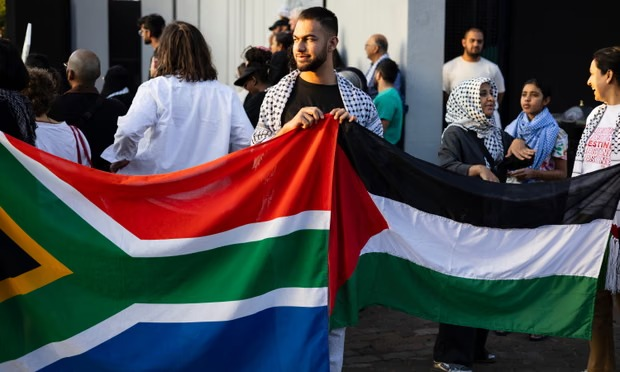
Protesters hold flags and placards at a demonstration organised by the South African Jews for a free Palestine group in Johannesburg. Photograph: Kim Ludbrook/EPA
By Ricardo Mohrez Muvdi
For decades, the international community has compared Israel’s system of occupation and segregation in Palestine to South African apartheid. However, beyond the formal similarities, there are differences that reveal the true nature of the Zionist project and its colonial scope. It is not merely a racist regime — as South Africa’s was — but an ideology that seeks to replace an entire people with another, erasing their history and their very existence.
In South Africa, apartheid was an institutionalized system of racial discrimination imposed by a white minority over a Black majority. Its goal was clear: to maintain political, economic, and social control in the hands of whites while relegating the Black population to separate territories, stripped of full rights and under constant surveillance.
It was a brutal regime, yet one based on the exploitation of African labor. The apartheid economy needed the Black people: it subjugated them, controlled them, and used them as an indispensable labor force. In other words, South African racism depended on the oppressed for its own survival.
Zionism, by contrast, does not seek to exploit the Palestinian — it seeks to eliminate them. Its objective is not the subordination of one group to another within the same territory, but the total replacement of one people by another through expulsion, denial, and dehumanization.
Since 1948 — the year of the Nakba, the Palestinian catastrophe — the Zionist project has followed a classic colonial logic: to seize the land, destroy memory, and rewrite history. While South African apartheid said, “you will live apart,” Zionism says, “you must not exist.”
In the occupied territories, Israel has established a system of control that combines military laws, land confiscation, demolitions, colonization, and a wall that fractures everyday life. Yet the gravest aspect is that all this is justified under the discourse of security and self-defense, when in reality it is a political project aimed at erasing Palestinian identity from its natural geography.
South Africa was eventually sanctioned by the world. Apartheid was declared a crime against humanity, and international pressure — combined with internal resistance — brought the regime down.
Israel, on the other hand, enjoys impunity. The Western powers that were relentless with Pretoria now finance and protect the Zionist state despite its systematic violations of international law.
The result is a global double standard: racism is condemned once it has been defeated, but tolerated — even rewarded — when the oppressor disguises itself as the victim.
The fundamental difference between South African apartheid and Zionist Israel lies not only in form but in intention:
The former needed the oppressed to sustain its economy; the latter seeks the disappearance of the oppressed to build an imagined “national purity.”
And while South African apartheid fell because the world chose to confront it, Zionism endures because the world — or much of it — has chosen to look away.
But history does not forgive indifference. Palestine, like South Africa before it, will rise again — because no wall and no army can defeat the truth or silence the memory of a people who refuse to disappear.
Text edition: Alexandre Rocha