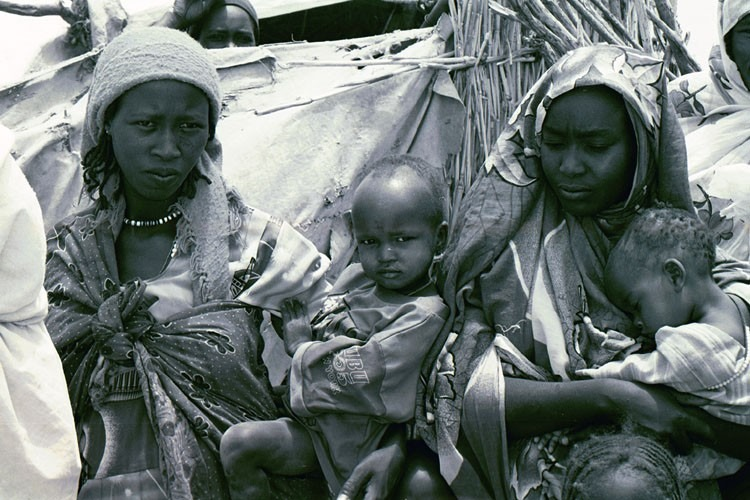
Refugees in a camp in eastern Chad, intended for refugees from the Darfur region of Sudan. Jerry Fowler visited the site in May 2004 to hear the refugees' accounts of the genocidal violence they suffer. US Holocaust Memorial Museum/Jerry Fowler
“When gold shines brighter than human life, genocide ceases to be an exception and becomes policy.”
An Invisible Tragedy
Since April 2023, Sudan has been descending into an abyss of violence that the world stubbornly chooses to ignore. The conflict between the Sudanese Armed Forces (SAF) and the Rapid Support Forces (RSF) has turned Darfur into a stage of ethnic massacres, mass rapes, deliberate starvation, and the systematic destruction of entire communities.
In West Darfur, the Masalit people have become the primary target of an extermination campaign led by the RSF and allied militias. Burned villages, bodies in the streets, and the blockade of humanitarian aid form the latest chapter of a war that, according to the U.S. Department of State, constitutes genocide.
In January 2025, Washington officially recognized the RSF’s crimes. Yet this diplomatic gesture, though symbolically importante, has neither stopped the killings nor concealed the intricate web of complicity and international interests that allow the genocide to continue.
The UAE and the Machinery of Gold
Behind the weapons that sustain the RSF lies Sudan’s gold.
And behind the gold, the United Arab Emirates (UAE). Independent investigations and human rights reports reveal that Abu Dhabi has been the main destination for illegally mined gold from Darfur, directly financing the forces of Mohamed Hamdan Dagalo, known as “Hemedti.”
Both The Guardian and Amnesty International have traced military equipment exported to the UAE and later found in RSF possession. The triangulation is clear: weapons, gold, and diplomatic silence. Despite official denials, the evidence remains consistent. The UAE government, keen to present itself as a broker of “regional stability”, now stands accused of fueling genocide with the same cold pragmatism it applies to oil and defense deals.
The United States and Its Double Standard
Washington has imposed sanctions on RSF leaders and companies involved in the conflict, yet its response lacks moral coherence. The U.S. recognizes the genocide while maintaining close military and commercial ties with the UAE, a key player sustaining the RSF.
The selectivity of American foreign policy is glaring. While official rhetoric speaks of “humanitarian responsibility,” strategic calculation continues to prevail. The sanctions fail to strike at the economic heart of the conflict, and no concrete measures have been taken to halt the flow of weapons and resources from allied nations. In practice, America’s response is theater—a symbolic gesture in the face of a very real genocide.
Israel and the Normalization with Sudan’s Military Regime
Israel’s role in Sudan is more discreet, yet geopolitically significant. Since 2020, Sudan has joined the group of Arab countries that normalized relations with Tel Aviv, in a deal brokered by Washington and backed by the UAE.
While there is no evidence of direct Israeli involvement in the massacres, the normalization process consolidated a regional axis of strategic interests, where territorial control and the containment of Islamic movements outweigh any humanitarian concern.
This alliance, formally “for peace,” has in practice legitimized military authoritarianism and deepened the isolation of Sudanese victims, leaving genocide at the margins of international attention.
Darfur and Gaza: Genocides Under Unequal Light
The parallels between Darfur and Gaza are deeply unsettling. In both regions, civilian populations face systematic annihilation under the pretext of “national security.” Both endure blockades, starvation, the destruction of hospitals, and targeted attacks on refugees, met with a global response marked by selective outrage.
The difference lies in visibility: Gaza, even beneath rubble, is seen. Darfur, in ashes, is not. The African tragedy is treated as collateral, peripheral, almost disposable. This disparity exposes the structural racism embedded in international coverage and the implicit hierarchy of human lives. Both genocides, however, stem from the same imperial logic: the normalization of violence as a political tool, and the complicity of states that profit from war.
The Failure of International Justice
In May 2025, Sudan’s government filed a formal complaint against the United Arab Emirates at the International Court of Justice (ICJ), accusing Abu Dhabi of financing genocide in Darfur. The Court’s response was devastating: “manifestly without jurisdiction.”
This refusal lays bare the collapse of the international human rights system. If a nation can fund genocidal militias without facing trial, then the very concept of justice becomes an abstraction.
The ICJ’s decision is more than a legal act, it is a political signal: Sudanese lives do not carry sufficient diplomatic weight to mobilize the powers that once vowed to defend the 1948 Genocide Convention.
Omission as Complicity
The genocide in Darfur is a moral test for the world. The international Community, mobilized selectively according to economic or strategic interests, has proven that neutrality in the face of barbarism is, in practice, complicity.
Darfur’s destruction is not an isolated event; it is part of a historical pattern in which Africa serves as a laboratory for global impunity. While leaders speak of peace and cooperation, defense corporations grow richer, banks launder gold, and governments calculate diplomatic gains.
There is no neutrality in the face of genocide. And if the world has finally, albeit belatedly, reacted to the horror in Palestine, it must also raise its voice for Darfur, before silence becomes permanent.
The genocide in Darfur is the cruelest mirror of our time: a massacre sustained by alliances, concealed by silence, and driven by interests dressed in suits and ties. To ignore it is to legitimize the next one. If humanity still holds any commitment to justice, the time to break the silence is now.