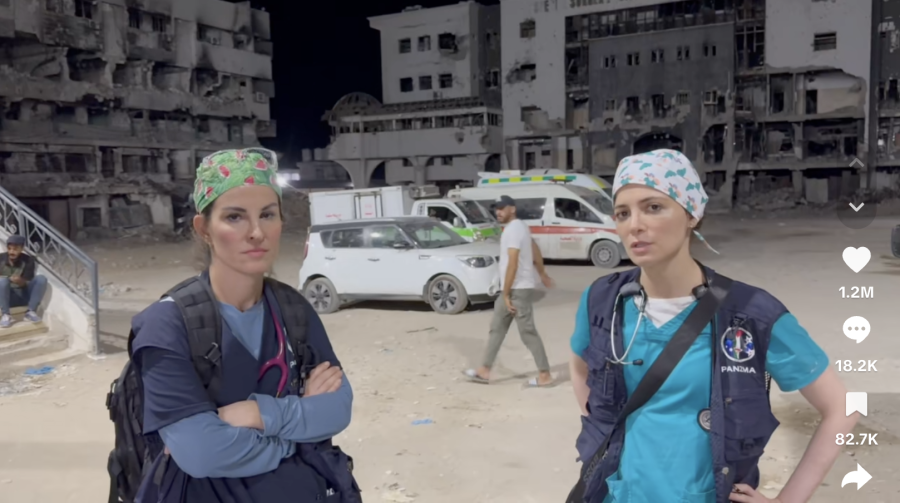
Dr Saya Aziz (L) and her colleague Dr Abu Al-Rub in their TikTok video
By: Alessandro Vitale, Mohammad Abu Hilal, Andrew A Gumbs,
Amir Szold, Umberto Cillo e Isabella Frigerio
The catastrophic humanitarian crisis in Gaza, with the apparent deliberate targeting of health-care infrastructure and personnel, has highlighted a profound challenge to the global medical community. Hospitals are under siege and clinicians are operating without basic supplies, power, or safety.1,2 We are all deeply concerned about the suffering civilian population in Gaza and Israeli hostages, who are both living under inhumane conditions after the massacre of Oct 7, 2023.2
WHO and UN agencies have reported at least 772 attacks on health care,3 with 94% of hospitals damaged or destroyed2 and more than 1500 health-care workers killed4—the highest toll ever recorded.5,6 No independent or neutral organisation has provided evidence that Hamas deliberately used hospitals or other civilian facilities as human shields.7 Even if proven in the future, such claims could never justify systematic attacks on the health-care system. This is a violation of international humanitarian law and demands explicit condemnation.1,2 Most medical and surgical societies worldwide have remained silent or issued vague statements about Gaza’s healthocide. A recent analysis found that only 24·5% of US speciality societies commented publicly on the Gaza conflict,8 in contrast to previous crises in which medical societies mobilised resources and expressed support.9–12
The value of human life should not depend on nationality, religion, or political alliances. In fact, both Israeli and Palestinian physicians took care of those injured during the tragedy of Oct 7, 2023—proof that health care can be empowered to build bridges of trust.13 Organisations should also try to balance action to end the Gaza catastrophe with an attempt to support physicians and scientists in Israel who are making an effort to change the situation from within.
This is beyond politics; this is about care. Some say that medical societies must remain apolitical. However, ignoring political issues that affect health means ignoring real barriers to care. Staying silent while pretending to be neutral is, in effect, a form of complicity.
The principle of medical neutrality, grounded in international humanitarian law, does not mean indifference; it obliges us to condemn any erosion of this norm as a threat to both care and ethics. As the World Medical Association’s Declaration of Geneva affirms, physicians must act in the interest of humanity, especially in times of crisis.14
The Israeli Medical Association urges the provision of medical assistance to all humans indiscriminately.15 As doctors, we must support all victims of conflict, denounce attacks on medical staff and facilities, and ensure care reaches those in need (appendix).
Let us be remembered for our solidarity, not our silence. This is a decisive moment. Future generations will judge whether we defended life or looked away. Medicine is more than science—it is a moral duty. And when that duty is under threat, silence becomes betrayal.
Competing Interests
We declare no competing interests. We acknowledge the official endorsement of this Correspondence by the European Digestive Surgery Society. This Correspondence has been endorsed by seven colleagues from Surgeons of Gaza (appendix).
Editorial note: The Lancet Group takes a neutral position with respect to territorial claims in published text and institutional affiliations.
Supplementary Material (1)
Supplementary appendix
References
De Vogli, R ∙ Montomoli, J ∙ Abu-Sittah, G ∙ et al.
Break the selective silence on the genocide in Gaza
Lancet. 2025; 406:688-689
WHO
Health system at breaking point as hostilities further intensify in Gaza, WHO warns
Date: May 22, 2025
Date accessed: August 7, 2025
WHO
oPT emergency situation update
Date: Aug 21, 2025
Date accessed: August 27, 2025
UN Office for the Coordination of Humanitarian Affairs
Reported impact snapshot – Gaza Strip
Date: Aug 20, 2025
Date accessed: August 27, 2025
Abi-Rached, JM ∙ Sharara, AI ∙ Nasrallah, MP ∙ et al.
Healthocide and medical neutrality: a call for action and reflection
BMJ Glob Health. 2025; 10, e018656
Physicians for Human Rights
1000 attacks on health care in the Occupied Palestinian Territories (OPT) devastate health system, demand accountability
Date: Aug 2, 2024
Date accessed: August 27, 2025
UN
Security Council debates Israeli attacks on hospitals allegedly misused by Hamas, as UN Rights Chief urges independent probes
Date: Jan 3, 2025
Date accessed: August 27, 2025
Pagadala, MS ∙ Nichols, N
Responses to the Gaza-Israel conflict by specialty medical societies
JAMA Netw Open. 2025; 8, e254662
Niu, H ∙ Bedggood, M ∙ Jenkins, M ∙ et al.
Genocide in Gaza: moral and ethical failures of medical institutions
Lancet. 2025; 405:2271-2272
Arnaouti, MKC ∙ Cahill, G ∙ Baird, MD ∙ et al.
Medical disaster response: a critical analysis of the 2010 Haiti earthquake
Front Public Health. 2022; 10, 995595
World Medical Association
WMA resolution in support of medical personnel and citizens of Myanmar
Date: Nov 15, 2021
Date accessed: August 3, 2025
World Medical Association
WMA resolution in support of medical personnel and citizens of Ukraine in the face of the Russian invasion
Date: Oct 26, 2022
Date accessed: August 3, 2025
Abu Fraiha, Y ∙ Ahmed, A ∙ Alon, N ∙ et al.
Health care bridges—pathways toward trust in Gaza and beyond
NEJM. 2025; 392:1145-1148
World Medical Association
WMA declaration of Geneva
Date: May 31, 2024
Date accessed: August 3, 2025
Israeli Medical Association
IMA position on the treatment of wounded Gazans
Date: 2025
Date accessed: August 10, 2025


Comments are closed.