
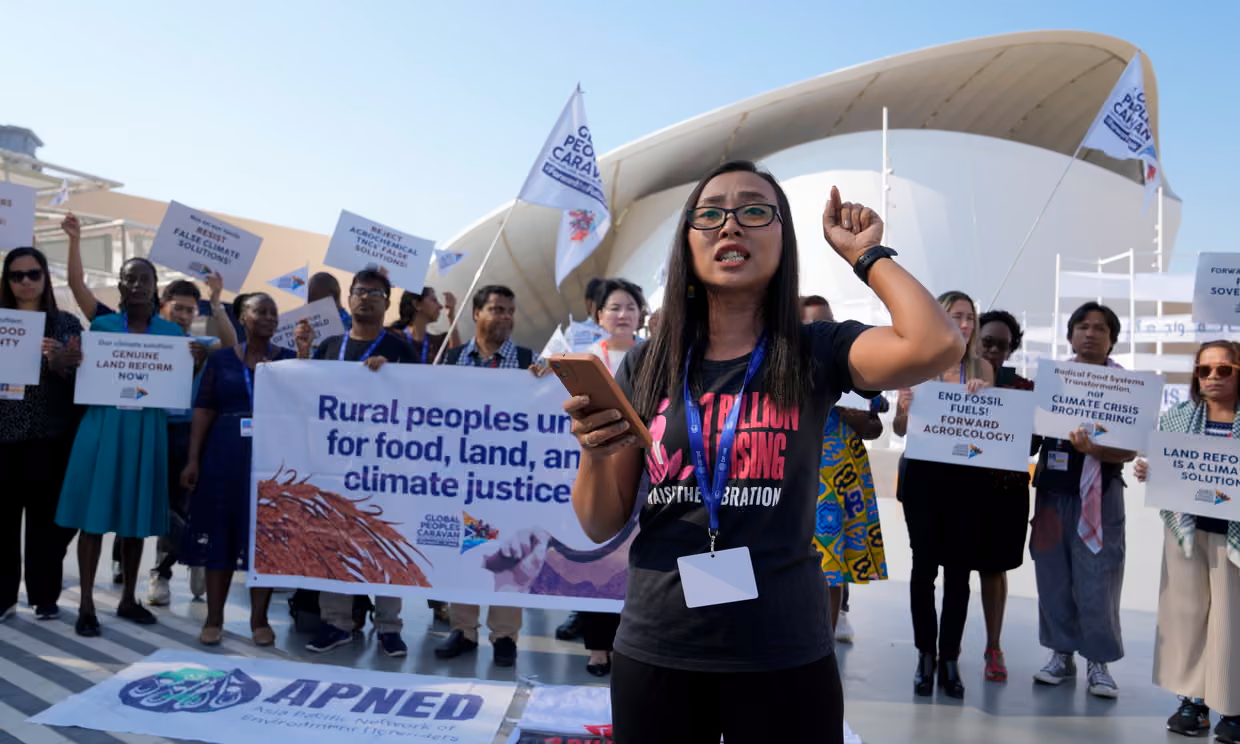
Activists demonstrate for rural people, food, land and climate justice at the COP28 UN climate summit in Dubai. Photograph: Kamran Jebreili/AP
By Gabriel De Angelis
The true warriors of the cause
- They are Indigenous peoples, riverine and quilombola communities, scientists, activists, and entire populations who live in and protect the forest with their bodies and souls.
- They fight against deforestation, defend their territories, and face real threats—often without institutional support.
- They represent the “wheat” of this struggle: coherence, courage, and a genuine commitment to life.
The trade in the environmental cause
- There is a growing market for environmental projects that, under the veneer of sustainability, conceal financial interests.
- NGOs, consultancies, and even representatives at international conferences often use the ecological agenda as a springboard to raise funds, without delivering tangible results.
- The Indigenous and forest causes are, in some cases, instrumentalised to attract international funds—yet the benefits rarely reach the communities directly involved.
The global and national context
- At COP30, to be hosted in Brazil, it is worth recalling that over 1,700 lobbyists from the oil sector attended the previous conference, raising serious doubts about the integrity of climate negotiations.
- Organisations such as WWF, Greenpeace, and the Socio-Environmental Institute have warned of the excessive presence of representatives from polluting sectors such as agribusiness and fossil fuels.
- Brazil, in fact, was the second country with the highest number of meat industry lobbyists at COP29.
Separating the wheat from the chaff
- Transparency must be demanded in projects funded by environmental funds such as those of the UNDP, international banks, and multilateral programmes.
- Mandatory declarations of interest should be implemented for anyone involved in climate negotiations and environmental projects.
- Mechanisms of social oversight should be created so that local communities can monitor and assess the real impacts of projects in their territories.
The environmental cause cannot be held hostage to vanity or profit. It demands ethics, listening, and concrete action.



Comments are closed.