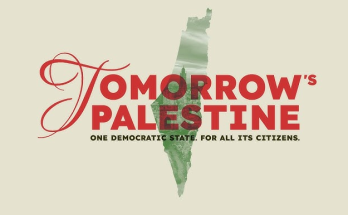
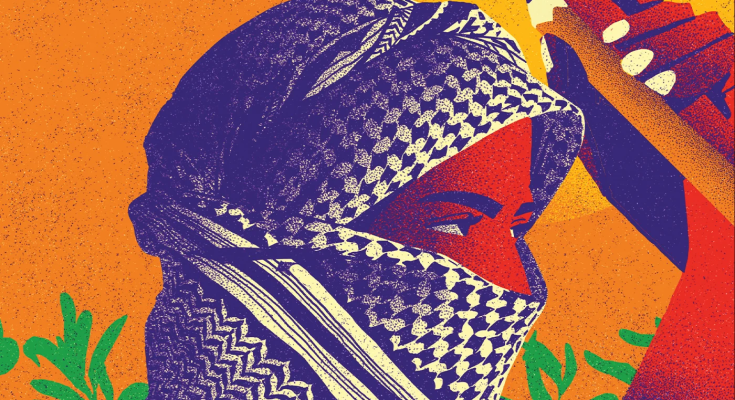
This poster by Venezuelan artist-activist Kael Abello is one of the hundreds that are free to share and distribute from Artists Against Apartheid, which issued a public call for art created in solidarity with Palestine. Poster by KAEL ABELLO @AGAINSTAPARTHEID.ART
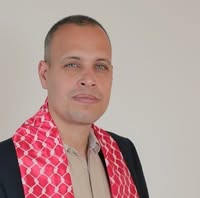
By Wisam Zoghbour, from Gaza
At a time when images shape consciousness more than bullets on the battlefield, Palestine is advancing to a new front of conflict: the front of words and consciousness. After decades of facing the occupation machine on the ground, Palestinians have found themselves fighting an equally fierce battle in the digital space, a battle against the silencing of voices, the distortion of truth, and the falsification of history. The digital transformation and the contemporary communications revolution have reversed the equation, granting Palestinians a weapon that tanks cannot counter: digital media and media diplomacy.
First: From Victim to Discourse Maker
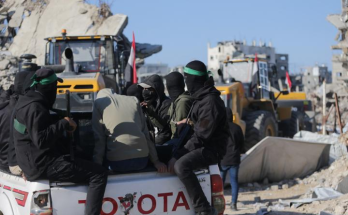
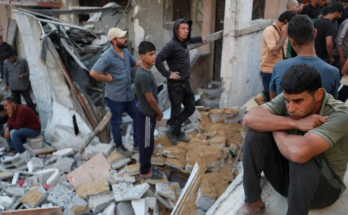
Palestinians have gone from being mere objects on the news to agents in the construction of the global narrative about their cause. Through social media, the traditional hegemony of large media conglomerates, which for a long time monopolized the narrative of events according to their political criteria, has been broken. Through live images and videos captured on the ground, Palestinians tell their stories directly to the world, without intermediaries or selective editing. Images from Gaza and the West Bank have reversed the Israeli narrative, which for a long time presented itself as a “victim,” and shown the world the true face of the occupation and its policies of repression and discrimination.
Second: media diplomacy,
a soft weapon as strong as steel
The media today is no longer just a vehicle; it is a tool for shaping attitudes and formulating policies. Here, the concept of media diplomacy stands out, combining the professional role of journalism with the strategic role of official and human rights institutions.
Each interview, statement, or organized digital campaign can become an instrument of international pressure, contributing to the formation of a global position favorable to Palestinian rights. This integration of media and diplomatic efforts today constitutes a new front in the struggle, based on image, words, and credibility.
Third: The Battle of Conscience in the Face of Algorithms
Despite the impact already achieved by the Palestinian digital presence, the challenges remain enormous. Large technology companies impose disproportionate restrictions on Palestinian content under the pretext of “incitement” or “violation of norms,” while turning a blind eye to Israeli racist and militaristic discourse. Furthermore, coordination between official and popular media remains limited, and investment in training and modern technologies remains insufficient.
Winning the battle of narrative in the age of algorithms requires understanding the digital mechanisms that shape public opinion, not just relying on ethical and fair content.
Fourth: Toward a Global and Integrated Media Strategy
For the Palestinian narrative to consolidate itself in the international consciousness, a comprehensive national strategy that unifies traditional media, digital media, and media diplomacy under a single vision is essential.
This strategy is based on four main pillars:
- Produce professional, multilingual content that speaks to reason and conscience simultaneously.
- Train Palestinian spokespersons and communicators capable of representing their cause with confidence and competence on international platforms.
- Build strategic partnerships with journalists, academics, and human rights organizations around the world to convey the Palestinian truth with depth and objectivity.
- Employ digital analytics and artificial intelligence tools to monitor public opinion trends and formulate effective and targeted communication.
Fifth: From Defensiveness to Initiative
The time has come for the Palestinian narrative to shift from a state of permanent defense to a proactive, humane, and universal discourse that presents Palestine not as a mere political dispute, but as a global symbol of freedom, justice, and human dignity.
The world today seeks not the cry, but the truth; not oratory, but the authentic story that illuminates human conscience. And Palestine possesses this, due to the sincerity of its experience and the depth of the injustice it suffers.
Words are an invincible weapon
The battle for the Palestinian narrative is not a media luxury, but a struggle for survival and identity. True words today constitute the collective memory of nations and preserve the truth from disappearing amid the noise of disinformation.
The Palestinian who raises a camera in front of a tank, or who publishes a tweet despite the digital blockade, practices an act of resistance as dignified as any other form of struggle.
In an age of images, words are the ultimate limit of freedom, and its first battle.
Text Editing: Alexandre Rocha