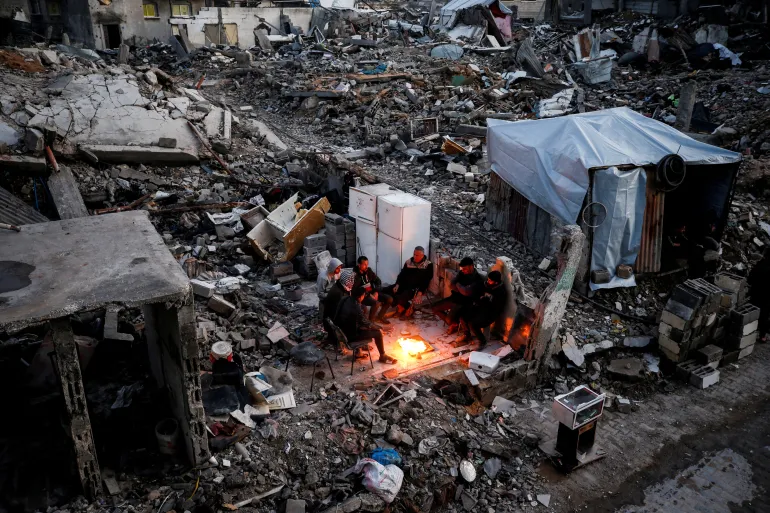
Palestinians gather near a fire surrounded by the rubble of destroyed buildings at Jabalia refugee camp, northern Gaza Strip [Mahmoud Issa/Reuters]
By Wisam Zoghbour, from Gaza
Two years after the war of extermination against the Gaza Strip, nothing remains of my home but rubble and ruins. It was not merely a structure of stone and cement, but an entire life scattered among the shattered rooms and the photographs that once told stories of warmth and safety. Neither the belongings of the house were spared, nor the small details that gave us a sense of belonging; and the heart itself did not escape the wounds of loss. The war tore from us loved ones and friends, among them two of my sister’s beloved sons, martyred in different places and moments, yet within the same scene that unites all Palestinian loss: a house is demolished, a childhood is murdered, and the sky erases its dreams.
The Gaza I know has never been enamoured with war, nor fascinated by destruction, as the Israeli occupation seeks to portray it to the world. This small city, besieged for more than a decade and a half, knows nothing but the love of life. It sings despite the siege and sows hope in soil soaked with patience and tears. In this great massacre, Gaza has proven that it does not worship death, as they claim, but clings to life as roots cling to the earth. It resists not merely to triumph, but to endure.
The house that collapsed was not merely walls and furniture; it was a miniature homeland in which we sheltered from the harshness of the world. It was a mirror of our memories, our dreams, and our seasons of simple joys. And when the house is erased, it feels as though a part of the greater homeland has been torn from our souls. Yet the loss of this small homeland does not drive us to depart. We shall not grant the occupation what it has long sought: to break our will or uproot us from our being.
The occupation is not content with destroying stone; it seeks to destroy meaning itself. It plants fear and pain in every corner, wrapping its crimes in deceitful terms such as “voluntary displacement,” as though a Palestinian in Gaza lived in the luxury of choosing between death and exile. As if we lived in some Platonic ideal city, and not in a besieged prison whose walls close in on us day by day.
And yet Gaza answers these lies not with words, but with deeds. Even beneath the rubble, it rebuilds its schools, reopens its windows to life, and paints its shattered streets with the laughter of children who have returned from the edge of death. Gaza does not die; it rediscovers itself every day—slowly, yet with an unbending steadfastness.
Yes, the house has fallen and the loved ones have gone, but the spirit remains. From every corner of the rubble, a flower blooms; and from every demolished home, a new story of resilience and determination begins. We remain here—not because we have nowhere else to go, but because we possess something of inestimable worth: this land is ours, and here we shall stay.
Text Editing: Alexandre Rocha