Gilliam Nauman Iqbal*
Palestinian Women’s Resistance: An Anti-Colonial Feminism?
We begin this text by citing the alarming figure presented by Soraya Misleh concerning the deprivation of liberty suffered by Palestinian women engaged in defending their land and identity – a resistance expressed in various forms, in addition to the physical torture to which they are subjected. Forty-eight Palestinian women are currently held in Israeli prisons. Soraya provides this information through a report produced by the Palestinian organisation Addameer, a movement in support of Palestinian prisoners. In the ongoing attempts to erase an entire people, the ethnic cleansing carried out by the Israeli state requires no major act of “rebellion” – merely being born Palestinian is sufficient justification for imposing punishment, demolitions, imprisonment, bombardment, assassinations, and terrorism.
The Palestinians’ struggle to maintain their existence has been relentless for over seventy years, ever since the loss of their territory gave way to blocks of land patrolled by armed Zionists, inflicting daily terror upon the elderly, women, and children. With their homes demolished and their sons, husbands, fathers, and brothers imprisoned or killed, Palestinian women are driven into the fight – whether confronting military force directly or developing other forms of resistance.
It is common in the daily life of a Palestinian woman to carry on without her husband, who is often killed by Zionists or held in an Israeli prison. This reality leaves these women vulnerable to the violence of settlers illegally occupying the land.
Another grim fact is that, on top of violence and deprivation, Palestinian women face the harsh reality of obstetric violence or even the absence of the necessary care during pregnancy. In Gaza, for example, pregnant Palestinian women are denied prenatal care. Statistics show that newborn deaths are often caused by the refusal of assistance at Israeli checkpoints during labour – yet another Zionist strategy to decimate this population from the womb. The dire humanitarian situation faced by these women is worsened by unemployment and the lack of even the most basic means of subsistence.
In 2019, Zionist snipers killed Palestinian woman Amal al-Taramsi, and the list of such criminal acts committed by Israel continues to grow.
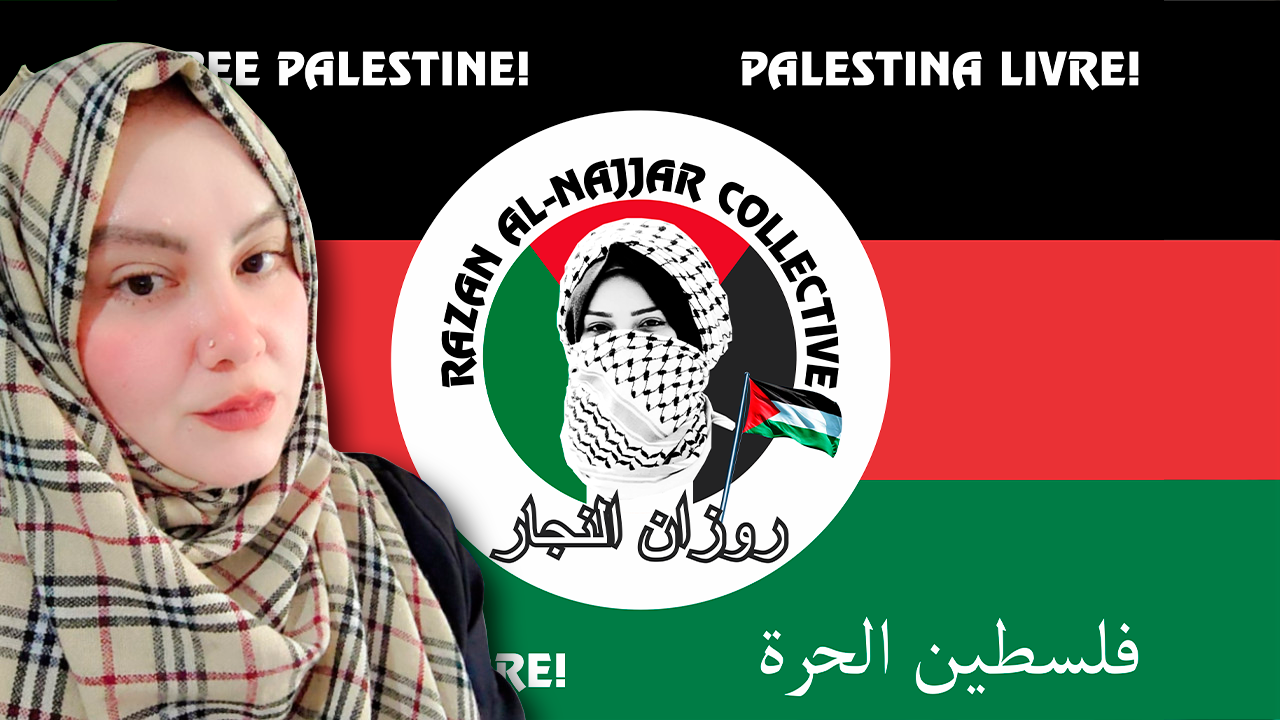
Among so many tragic and cowardly cases is that of paramedic Razan al-Najjar, aged 21 – the woman whose memory we chose to honour by naming our movement after her: the Palestinian Alliance Razan al-Najjar – MA. Al-Najjar was murdered in the line of duty while tending to the wounded during protests along the Gaza-Israel border on 1 June 2018, shot by an Israeli occupation soldier. The killings in Palestine carried out by occupation forces are countless, with women increasingly among the victims.
The policy of sniper fire is one of the brutal tools of the ethnic cleansing imposed by the illegitimate State of Israel, which for more than seventy years has sought to annihilate and erase the Palestinian people from the world.
Throughout the occupation, Palestinian women have endured all forms of abuse and violence against their bodies. It is not only the land that is illegally occupied – women’s bodies have become an extension of this violent colonisation.
The displacement of 800,000 Palestinians and the destruction of 500 villages include within their toll the sexual violation of numerous Palestinian women, part of the extensive list of crimes committed in the thirty-one villages where Zionists carried out massacres.
The conditions imposed by colonisation have stirred in Palestinian women the spirit of anti-colonial struggle. This reaction to imperialism completely contradicts the media narrative about women in the East. In the Western collective imagination, these women are portrayed as naturally submissive, voiceless, and imprisoned in garments that violate their freedoms. Eurocentrism refuses to recognise that such markers of identity are carried with pride, and that these women follow a cultural code that grants them freedom outside Western norms. We must understand that patriarchy is a system that engulfs the entire world and is present in all cultural systems. Everywhere, women organise to reclaim rights and spaces.
There is no single feminism – there are feminisms. We cannot standardise struggles across the world into a single Western “mould”.
The feminist movement loses much when it disregards the trajectories, ethnicity, culture, and spirituality of these women. A narrative of salvation has been constructed in which liberal, white, European feminism is cast as the force that must rescue these women from their society and native cultural systems. This discourse is weaponised by colonial domination.
A feminist movement that should adhere to an anti-oppression agenda ends up serving imperialist projects. Western feminism will never have the authority to speak on Muslim women’s clothing, framing it as a symbol of oppression (in the case of the hijab and other garments), because these women have an entirely different understanding of what constitutes oppression, freedom, and choice. Liberal feminism fails to grasp that there is also political appropriation in what should be a purely female choice within Islam, and that what must be resisted is the compulsory political imposition of such garments. The prohibition of the hijab in some European countries triggers defiance, demonstrating that these women do not feel oppressed by their attire or by the codes of their religion; on the contrary, they feel free and fight to preserve these elements.
The analysis of such episodes reveals exactly how the instrumentalisation of the feminist movement – as previously mentioned – bolsters imperialist projects structured around Zionist agendas, portraying the East as a place of barbarism and backwardness in need of rescue by a “civilised”, white plan. Such a “civilised”, white plan means denying these peoples the capacity for self-governance, creating stereotypes of inherently violent men shaped by geographic and cultural determinism, and therefore justifying their domination through a colonial project.
By adopting this policy of cultural lynching, we can observe similar phenomena in Latin America after far-right governments seized power in certain countries, as in Brazil. The “natural” result of this political anomaly has been inflammatory, prejudiced, and xenophobic rhetoric. On several occasions, President Jair Bolsonaro adopted positions and made statements in line with this discriminatory ideology of erasure of Eastern peoples, openly declaring support for Israel and its Zionist practices.
In a more sophisticated tone, in Europe, France – ostensibly a defender of the secular State – engages in fierce persecution of Islam, employing the same discriminatory discourse of barbarising a culture and the false notion of “saving” Muslim girls supposedly imprisoned by the veil. Emmanuel Macron’s policy contradicts the very principle of secularism, which, by definition, is the principle whereby all faiths may coexist in the same space without interference by the State in religion or vice versa.
The struggle of Palestinian women brings together various elements that make this resistance a new form of feminism. Here we have women who, facing the massacre of their people and the gender oppression inherent in the patriarchal structures of their culture, rise up in anti-colonial and anti-gender oppression struggle. The movement is strengthened by intersections with Islamic feminism, sectional feminism, anti-racist feminism, and even Marxist feminism when we consider the struggle for the rightful possession of land and opposition to imperialism.
The history of Palestine since the occupation is full of actions led by women. Between 1936 and 1939, a woman led the storage of weapons for the rebels: Fatma Khaskiyyeh Abu Dayyeh was not only the custodian of arms but also commanded a group of one hundred women during the Nakba in 1948. In a more assistance-based role linked to the Palestine Liberation Organisation (PLO), the General Union of Palestinian Women was created in 1965. The need for representation and stronger defence of Palestine led many women to adopt a more combative stance in the face of the international human rights bodies’ silence on the occupation and its constant violations.
In the Popular Front for the Liberation of Palestine (PFLP), the most iconic female figure was militant Leila Khaled, who from her youth became an active participant in the fight against the Israeli occupation. As a teenager, Leila joined the Arab Nationalist Movement. Years later, she joined the Marxist–Leninist Popular Front for the Liberation of Palestine. Her most famous action took place on 6 September 1970, when she hijacked an El Al flight from Amsterdam to New York, for which she was detained.
Women have always played an active role in all acts of resistance to secure their people’s autonomy, their land, and the preservation of their collective memory. In the Intifadas of 1987–1993 and 2000–2004, women – especially from rural backgrounds – were at the forefront. Under colonisation, women are the most affected, as the vast majority find themselves in complete despair, unemployed, heading families, protecting children from Zionist violence, and yet refusing to abandon the fight. Amid the bleak landscape of occupation, they manage to organise politically into associations to fight for the bare minimum to survive.
From a young age – often in childhood – these women gain awareness of the struggle to preserve the elements essential to their own and their people’s existence. It is common to see children confronting soldiers, proudly carrying the Palestinian flag as an act of resistance against Israeli forces. Many have their childhoods violated and are even imprisoned and tried as adults.
Israel, often touted as a model democracy in the Middle East, cannot even muster a coherent policy and reveals its monstrosity by enacting laws that criminalise a child’s anger at seeing their home demolished, their parents imprisoned, and their life destroyed. There is currently an average of four hundred children in Israeli prisons.
Regarding child imprisonment, we recall the story of Ahed Tamimi, detained for allegedly striking a Zionist soldier. The Tamimi family has a history steeped in resistance against Israeli imperialism. Many members of her family are active in the struggle, and the young woman has become a symbol of defiance against the violations suffered by Palestine. Ahed was released in August 2018 after eight months in prison, and upon returning home, her first words were: “The resistance will continue until the occupation ends.” Ahed will always stand as proof that the defiance and dignified, combative spirit of the Palestinian people lives in the DNA of this generation, and today, at twenty years of age, she is a reference point in the fight of women against colonial gender oppression.
The struggle of women in Palestine should be embraced by anti-colonial feminism and all others, for regardless of the specific banners of each movement, cohesion is built on solidarity and the fight against all forms of oppression. It is essential to protect the voice of these women – veiled or not – and to recognise the mechanisms of resistance they develop, whether through military uprising, associations focused on health, education, work, and politics, through the arts, or even through the act of offering their bodies to ensure the Palestinian people will never disappear.
In feminist struggle, it is necessary to recognise and reframe any action or mechanism that groups of women develop to resist systemic oppression. In Palestinian resistance, giving life is an act of defiance. The motherhood of Palestinian women cannot be analysed within the framework of family construction, reducing it to the act of bearing children alongside a man to form the traditional nucleus of society. In this context, Palestinian motherhood must be detached from any patriarchal framework. Being a mother in occupied territory means keeping memory alive, preserving history, and strengthening the revolutionary ranks that will carry on the resistance. It is no coincidence that Zionist policy sabotages these women’s pregnancies, denying them obstetric care, medicines, and even assistance during childbirth. Many children die at birth or in the womb; many are born underweight or malnourished. To be born Palestinian is already an act of struggle. The identity of Palestinian women is forged in a militarised, defiant context, steeped in symbols that preserve their people’s memory through the flag and the keffiyeh.
However, it cannot be denied that the Palestinian womb becomes a vehicle of militarisation. The body of the Palestinian woman is doubly occupied: if violated, it is occupied by the coloniser; if fertile, it is occupied by the necessity to generate resistance.
Within the feminist frameworks we have, Palestinian women’s struggle finds its place in Islamic feminism – particularly when motherhood is seen as a form of resistance, and when the re-signification or free interpretation of Qur’anic scripture is considered, recognising patriarchy in the code as specific to a given time. Islamic feminism highlights everyday resistance – the daily fight to reclaim a place that was always guaranteed in the sacred texts and that was never invisibility or submission to men, but rather equality. The aim of works discussing this struggle is to encourage feminist movements to open themselves to this perspective and embrace the journey of these women.