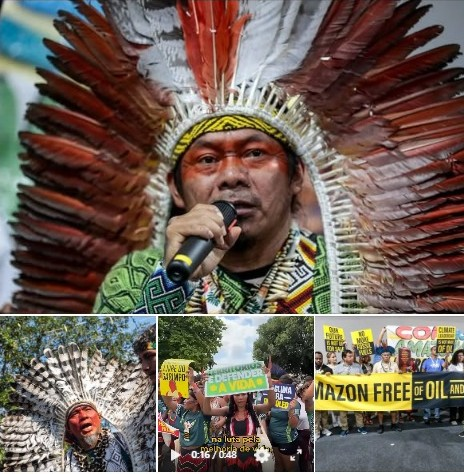
Image credit: @oliverninja and @midianinja, via Instagram
By: Amyra El Khalili
March 18, 2013
“Strike the viper’s head with the fist of its enemy.
From this there will necessarily come a good:
if the enemy prevails, the viper will die.
If the viper prevails, you will have one enemy less!”
– Fátima Sad El Din
I left a part of myself in the state of Acre when I placed a keffiyeh over the shoulder of the great Indigenous leader Ninawá Huni Kuin during the lecture I delivered, at the invitation of the Indigenous Missionary Council (CIMI), at the Federal University of Acre, in 2013.
Our martyrs are veiled and buried wrapped in the keffiyeh
A symbol of the struggle against the occupation of Palestinian territories, the keffiyeh has become an emblematic garment of activists in solidarity with the Palestinian cause around the world.
For the Palestinian people, the keffiyeh represents the beginning and the end. The everything and the nothing. It is the open manifesto of those who refuse the infamous peace of the tombs.
Indigenous Nakba
Expelled from their territories and massacred for 525 years on this continent, Indigenous peoples are an example of resistance and wisdom in caring for the environment and, even plundered of their lands, they still find the strength to show solidarity with the Palestinian people, victims of the Nakba (the tragedy of occupation) for 77 years.
In the lecture, I described how, in practice, the machinery of the financialization of nature and the plunder of Indigenous and peasant territories in the Amazon operates.
I spoke about the origins of the carbon market and its military motivation – the so-called “Bubble Council” in the 1960s. I analyzed the formation of emissions trading from the 1970s onward, later during Eco-92 and the Kyoto Protocol (1997), and I drew parallels about the costs of wars for Middle Eastern peoples and the similarities between what happens there and what is happening here.
I addressed the meaning of territoriality; the relationship of water as a living being for desert peoples and its importance for the survival of all beings on the planet – both spiritually and economically – and the relevance of this understanding for the confrontation between neoliberalism and emancipatory popular forces, especially in the Amazon, a region where “all cats are gray”.
We crossed the desert singing and dancing in a Bedouin-Indigenous caravan and reached the tropical forests telling stories, while the lost wander on the surface, arriving nowhere as they defend, as a solution to the environmental crisis, the financial contraptions: REDD, REDD+, PES, CERs, PSE, CDM, compensation credits, carbon credits, effluent credits, etc., etc., etc.
For a long time, I have warned that all of this is one and the same thing. Yet those who intend to confuse want us to believe that each acronym represents something different and thus attempt to justify the unjustifiable: that the financial market solves everything through the market itself. That the market self-regulates and would be capable of efficiently combating the harms affecting the environment.
If they seek to provoke social convulsions with their neoliberal doctrines to implant carbon neo-colonialism as an experiment, using forest peoples as guinea pigs, then we must congratulate them: in this endeavor, their objectives are succeeding. We are witnessing violent conflicts within the forests and in the countryside when we raise our voices against the usurpation of land, the plunder of common goods, and the violation of human rights, enabled by legislative reforms – as denounced by the Dossiê Acre Collective.
What happens in the Middle East, for the unwary, will never happen here in the Global South. And we Palestinians are called terrorists, radicals, and fundamentalists for warning about yet another assault committed by actors we know very well – responsible, with first and last names, for crimes against humanity. This strategy deployed against Indigenous nations and forest peoples is identical to the one that has exterminated thousands of Palestinians, Iraqis, Afghans, Lebanese, Syrians, Africans, and other relatives. As the Bedouin proverb says: “In the desert, truth is the best camouflage – because no one believes it.”
It was in that Indigenous April of 2013, in a ritual of pajelança and Indigenous intifada, that the warrior Ninawá Huni Kuin, his family, his people, companions, and relatives (those on this side) received the spiritual protection – the keffiyeh – from the Bedouin people (those on the other side), under the watchful eyes of the world. Just as it was the path – the beginning and the end – of the one who fell in defense of the Amazon: the Palestinian martyr Chico Mendes.
We Will Not Leave
By Tawfic Zayyad
Here
Upon your chests
We persist
Like a wall
In your throats
Like shards of glass
Unshaken
And in your eyes
Like a storm of fire.
Here
Upon your chests
We persist
Like a wall
Washing dishes in your houses
Filling the glasses of the masters
Scrubbing the tiles of the blackened kitchens
To tear away
The food for our children
From your blue jaws.
Here
Upon your chests
We persist
Like a wall
Hungry
Naked
Defiant.
Declaring poems,
We are the guardians of the shadow
Of the orange trees and the olive trees
We sow ideas like yeast in the dough
Our nerves are of ice.
But our hearts vomit fire
When we thirst
We will squeeze stones
And we will eat earth
When we are starving
But we will not leave
And we will not be stingy with our blood.
Here
We have a past
And a present.
Here
Lies our future.
Notes
Lecture delivered on April 12, at 7 p.m., at the Garibaldi Brasil Amphitheater of the Federal University of Acre, during the “Indigenous April 2013” program, organized by the Indigenous Missionary Council (CIMI), the Federation of the Huni Kuin People of Acre (FEPHAC), the Rural Workers’ Union of Xapuri (STTR-Xapuri), the Mission Council Among Indigenous Peoples (COMIN), and the Center for Research on State, Society and Development in the Western Amazon of the Federal University of Acre (NUPESDAO/UFAC). Participants included: Ninawá Huni Kuin (president of FEPHAC), Dercy Teles de Carvalho (president of STTR-Xapuri), Lindomar Padilha (CIMI), and Prof. Elder Andrade de Paula (CFCH/UFAC).
Tawfic Zayyad, Palestinian writer and poet from Nazareth, is considered a pioneer of resistance poetry. Much of his work was written in prison.
Originally published on March 18, 2013
Pravda-RU (Portuguese edition)