By: Noha Khalaf
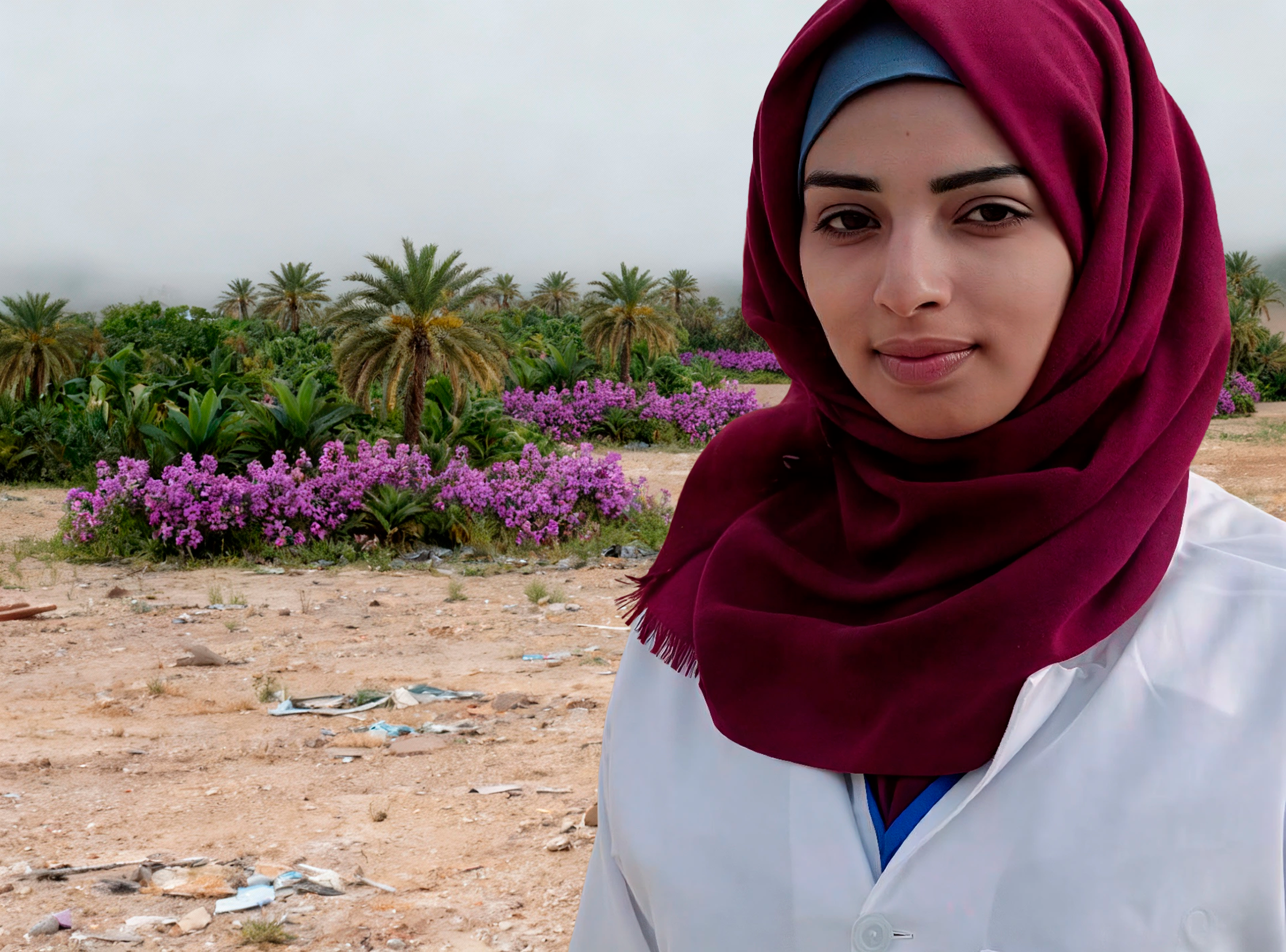
Razan al-Najjar, the healer, an angel of mercy, the Tyrian purple flower of Palestine, was only twenty one years old, when she was assassinated and martyred on the first day of June 2018, shot by a criminal sniper from the Israeli army of occupation, while attending to her duty as a dedicated nursing volunteer, in the unarmed peaceful Palestinian March of Return, in Gaza.
Razan had written on her facebook page:
“If you ask who I am,
I am Palestinian,
and my heart is bound to my homeland.
I love my country…
my soul and my blood are worth nothing without it.”
And also:
“If you ask me whether I fear death,
I will answer that death does not frighten me.
If a hateful bullet strikes me,
then martyrdom shall be my destiny,
and my blood shall be, for my homeland,
an ornament, a perfume, and flowers.”
On the first day of June 2018,
Razan woke up as usual
to join the Great March of Return,
that set out from Gaza’s besieged great prison
towards the border occupied by Israel.
She carefully prepared her modest first-aid kit:
cotton, antiseptics, painkillers, gauze, injections…
any medical supplies she could find
to help the wounded.
That day, as on all others,
she walked in the rear lines of the march,
watchful and focused,
searching with all her strength
for anyone in need of care.
Then she saw him approaching the barrier of death.
He wore a keffiyeh.
She saw the snipers,
the rifles aimed at him.
She wanted to cry out:
Beware!
But no voice came.
His steady steps showed calm.
He knew he was right.
He was unafraid.
He was ready to face those cruel eyes.
Step by step,
he advanced slowly towards the barrier of death,
as if guided
by the symphony of a distant nightingale.
Even if she had shouted,
he would not have heard.
Then she heard the hateful bullets
tearing through his bones.
She looked at him
without blinking.
She watched the body fall.
She did not tremble.
She saw the wounds,
the deep red blood flowing.
She heard the cries of pain.
She stared at the border,
absorbing every detail.
She engraved his vows, his mission:
Razan meant steadfastness.
Her name meant wisdom.
There was no room for defeat or flight
in the dictionary of her conscience.
Razan, flower of the sea,
purple flower of Tyre.
Her address:
a vast prison
of forgotten humanity,
facing a raging barbarity.
Razan meant strength.
A purple flower of Tyre,
the colour of ancient Phoenician royal silk,
and the gentle sound of a nightingale,
an old Arab flute
facing bullets and fire.
Razan meant compassion.
She saw his blood flow,
deep purple,
and murmured as if he could hear:
“My soul is no more worthy than yours,
nor my blood more precious than yours.”
She looked again:
each second,
each instant,
was another life, another death.
She saw her days rush before her eyes.
Her ears filled
with a symphony of compassion
and longing for life.
Each second,
each instant,
counted before the final collapse.
She dreamed of the besieged sea,
of mermaids,
of mountains,
of churches and mosques,
of a beloved homeland.
As his blood flowed,
she felt her heart quicken,
while his heart faltered.
Each second,
each instant,
counted.
Another victim, another martyr.
She saw the rifle,
and then she saw the light.
Her choice was clear.
Razan is pride,
flower of the sea,
white butterfly,
hope, youth, tenderness, and beauty.
Would she have time to tell her mother
of her last deeds?
Or would she return to her warm arms
as a martyred daughter?
The moment of decision —
a fleeting second.
She walked towards the border, unarmed,
resolute,
step by step,
as if guided
by the song of the distant nightingale.
In a flash,
she raised the white dress of mercy above her head,
a flag of peace
before merciless eyes.
She walked firmly, looking ahead,
step by step.
Another flash —
and she leapt,
a white and free mare,
to rescue the wounded soul.
She had to be Razan,
to be tenderness,
to be Gaza,
to be Palestine.
They shot her
without mercy in their hearts.
Her heart stopped beating
together with his.
Her dreams turned to sand,
scattered across the sacred land,
and she became an icon.
Her white dress
was soaked with blood.
It turned into the purple of Tyre,
the royal colour of an ancient
Phoenician robe.