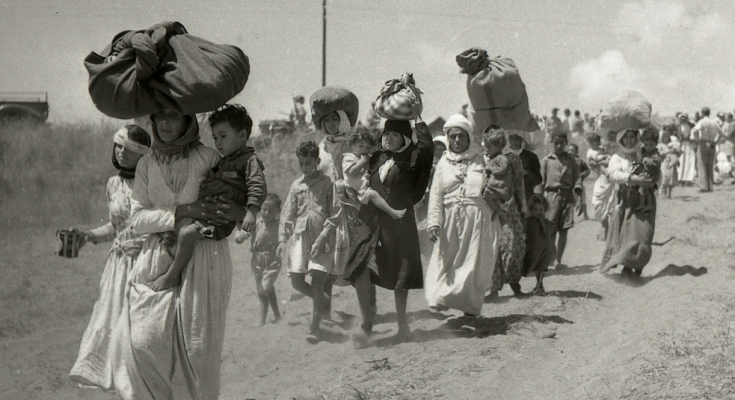
By Benno Rothenberg /Meitar Collection / National Library of Israel / The Pritzker Family National Photography Collection, CC BY 4.0, Commons Wikimedia
For more than seven decades, UNRWA—the United Nations Relief and Works Agency for Palestinian Refugees in the Near East—has been the main humanitarian, educational, and medical support for millions of Palestinians expelled from their land. Founded in 1949, after the violent creation of the State of Israel and the forced expulsion of more than 750,000 Palestinians, UNRWA was born to address an emergency that the world promised to temporarily resolve. But Palestinian exile became an open wound that still bleeds, and the agency became a symbol of resistance and memory.
Israel has been trying to destroy UNRWA for years. Its goal is not only to dismantle a humanitarian structure, but to eliminate the historical testimony of the Nakba. UNRWA is the only institution that preserves official records of Palestinian refugees: names, places of origin, destroyed villages, dispersed families. It is documentary evidence of Zionism’s founding crime.
That is why the Israeli government considers it dangerous. Because UNRWA’s very existence contradicts the Zionist narrative of “a land without a people for a people without a land.” Its archives contain living proof of the opposite: that there was a people, with history, culture, and roots, who were uprooted from their ancestral land to build a state based on the denial of the other.
For Zionism, eliminating UNRWA is a step toward the political and symbolic elimination of the Palestinian people. Without this agency, millions of refugees would remain invisible to the international community; and without them, the right of return—enshrined in UN Resolution 194—would lose its material and legal basis.
Despite the attacks, UNRWA continues to educate generations of Palestinian children, heal the wounded in Gaza, feed besieged families, and remind the world that Palestine has not disappeared. Every classroom, every hospital, every family record is an act of resistance against impunity.
Zionism fears UNRWA because it fears memory. Because whoever preserves memory also preserves the truth. And that truth—that of dispossession, of exile, of pending return—is indestructible.
As long as there is a single refugee archive, a single teacher teaching history in a UNRWA school, or a single Palestinian mother preserving her registration document, the Nakba cannot be erased.
UNRWA is not just an institution: it is the world’s conscience in the face of the injustice that has yet to be redressed.
Palestinian Union of Latin America – UPAL
October 16, 2025