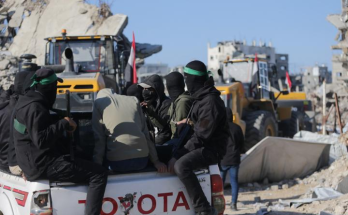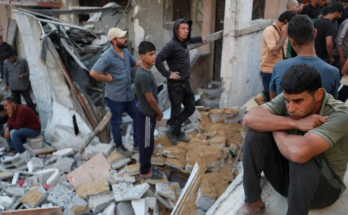

Palestinians displaced to the southern part of the Gaza Strip at Israeli orders during the war begin the trek back north to Gaza City after the ceasefire takes effect. Mahmoud Issa/Reuters
When Donald Trump announced his proposal to end the war in Gaza, many hailed it as a “historic peace plan.” However, upon closer examination, what emerges is not a consolidated peace agreement, but rather a conditional ceasefire, a pause with more questions than answers.
The text presented by Trump proposes an immediate cessation of hostilities, the reciprocal release of hostages and prisoners, the entry of humanitarian aid, and a partial withdrawal of Israeli troops. He also speaks of a “technocratic” Palestinian administration that would temporarily assume civilian management of Gaza, under international supervision. But beyond these initial gestures, no real political horizon is defined: there is no mention of Palestinian sovereignty, the right of return, the end of the blockade, or the occupation that fuels every outbreak of violence.
Trump, true to form, has presented this initiative as a personal achievement, without addressing the core of the conflict: continued colonization, the denial of Palestinian statehood, and Israeli impunity. A ceasefire may stop the bombs, but it does not heal the roots of the suffering. If the occupation is not ended, any ceasefire will be merely a temporary truce before the next outbreak.
Hamas has agreed to discuss prisoner exchanges and a limited transition, but without renouncing resistance or surrendering political control of Gaza without guarantees. Israel, for its part, sees the plan as an opportunity to impose an “administrative peace” that maintains its military and economic control. Thus, each party interprets the text according to its own interests, making the future of the agreement uncertain.
Arab governments that support mediation, such as Egypt, Qatar, and Jordan, know that without a comprehensive solution—including the West Bank, Jerusalem, and the complete lifting of the blockade—any attempt will be short-lived. True peace is not decreed from Washington nor imposed with conditions; It stems from the full recognition of the Palestinian people and their right to exist freely in their land.
Trump’s plan, in its current form, is a ceasefire with diplomatic aspirations, not a peace plan. It could be the beginning of something bigger if it becomes a serious process of decolonization and justice. But if it remains a temporary agreement without guarantees, it will go down in history as yet another episode of political manipulation disguised as hope.
And a fundamental principle must be underscored: no agreement or negotiation on the future of Palestine can be considered legitimate without the participation of all Palestinian factions. Only the Palestinian people, as a whole and through their national unity, have the moral and political authority to decide their destiny.
Meanwhile, the Palestinian people continue to pay the price of international impunity. And as so often, it behooves us to remember that peace is not built on promises, but on truth, justice, and freedom.
Palestinian Union of Latin America – UPAL
UPAL Editorial – October 11, 2025