
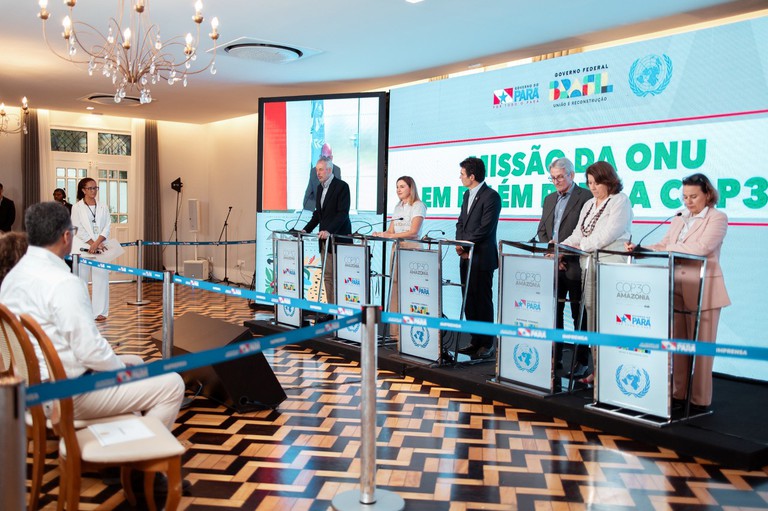
Ambassador André Corrêa do Lago; the Deputy Governor of Pará, Hana Ghassam; State Governor Helder Barbalho; Valter Correia, extraordinary secretary for COP30 Amazônia; Miriam Belchior, executive secretary of the Federal Government's Office of the Chief of Staff; and Noura Hamladji, from the UNFCCC, during a press conference on Friday, January 24 - Credit: Isabela Castilho / COP30 Amazônia
By Gabriel De Angelis
The hosting of COP30 in Belém, the capital of Pará, represents both a symbolic and strategic milestone for the global climate agenda. On the doorstep of the Amazon, the conference carries the expectation of placing tropical biomes and developing countries at the centre of climate negotiations. However, behind the diplomatic rhetoric and public commitments lie deep contradictions that expose the limits of international environmental governance.
The Deadlock of Climate Finance
According to the report of the 62nd Session of the UNFCCC Subsidiary Bodies, held in Bonn, the main obstacle to tangible progress is climate finance. The goal of mobilising US$ 1.3 trillion per year by 2030 still lacks clear mechanisms for implementation. Developing countries, which have historically contributed less to greenhouse gas emissions, continue to face the most severe impacts of the climate crisis without the resources needed for adaptation and mitigation.
“The logic of the Climate Convention is based on common but differentiated responsibilities. Yet in practice, wealthy countries have not fulfilled their part.” — Alexandre Prado, WWF-Brazil
Belém: Socio-environmental Vulnerability and Inequality
Studies from the University of São Paulo (USP) and the Sustentarea Centre reveal that Belém faces high levels of food insecurity (47% of the population), unplanned urban growth, and low income generation from agriculture. Despite being surrounded by the Amazon rainforest, the city suffers from flooding, pollution, and territorial inequality — challenges that call into question its ability to generate a lasting legacy after the COP.
“COP30 may be an opportunity to reorganise local environmental governance, but this requires coordination between governments and the participation of marginalised communities.” — Lima & Alves, UFPA (2025)
The UN and the Geopolitical Theatre
The United Nations, though central to climate negotiations, has been criticised for its vulnerability to pressure from major powers and multinational corporations. COP30 takes place amid a global scenario marked by wars, political backsliding, and growing disinterest in climate action. The withdrawal of the United States from the Paris Agreement and the rise of denialist governments make consensus-building increasingly difficult.
“What is lacking is political will. We need mitigation commitments to be honoured.” — Tina Stege, Climate Envoy of the Marshall Islands
Billion-dollar Profits versus Climate Justice
The debate on climate justice — which considers the ethical, social, and political dimensions of the environmental crisis — highlights that the costs of ecological transition cannot continue to fall on poorer nations. Without an equitable redistribution of benefits and responsibilities, COP30 risks becoming yet another exercise in political marketing rather than a genuine turning point.
Conclusion: Between Spectacle and Action
COP30 in Belém could be a watershed moment — or merely another chapter in the cycle of unfulfilled promises. Brazil, as host, has the chance to lead with courage and coherence, but doing so requires confronting powerful economic interests and amplifying the voices of those most affected. Without that, the conference will remain nothing more than a dog chasing its own tail.




Comments are closed.